What You're Really Buying When You Buy "Gold" Jewellery
Not all gold jewellery is what it appears to be. Walk into any online jewellery store and you'll find rings described as gold — made of brass with a gold coating so thin it can wear through in days. Worn on a finger every day, that coating is gone long before the year is out. The metal underneath tarnishes, reacts with skin, and leaves green marks where the ring contacts your finger.
This distinction matters more for an engagement ring than for anything else — it's worn every single day, through every task, for life. Here's exactly what the terms mean, and why it changes everything about what you should buy.
What Is a Micron? And Why It Should Alarm You
A micron (also called a micrometre, symbol: µm) is one-millionth of a metre. To put that in a physical context you can feel: a single human hair is approximately 70 microns in diameter. That is a hair on your head — already almost invisible to the naked eye, barely perceptible between two fingertips.
Standard gold plating on jewellery is 0.5 microns thick. That is one-hundred-and-fortieth the diameter of a human hair. If you took a single hair and sliced it lengthwise into 140 equal slices — each of those slices would be one gold-plated ring's worth of gold thickness.
Higher-end gold plating — the kind marketed as "heavy gold plating" or "thick plating" — reaches 2.5 microns. That is still under four percent of the thickness of a human hair. The difference between 0.5 and 2.5 microns determines whether your "gold" ring lasts four days or eight weeks of daily wear before the base metal begins showing through at the contact points.
To put this another way: the volume of gold applied to a gold-plated ring is so small it has negligible monetary value. You are buying a coating, not a metal.
The Four Types of "Gold" Jewellery
Solid Gold
Solid gold means the entire piece — all the way through — is a gold alloy. No base metal, no coating, no compromise. It's measured in karats: 18K is 75% pure gold, 14K is 58.5%, and 10K is 37.5%. The remaining percentage is silver, copper, or palladium alloyed in for hardness and workability.
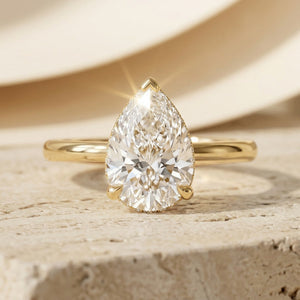
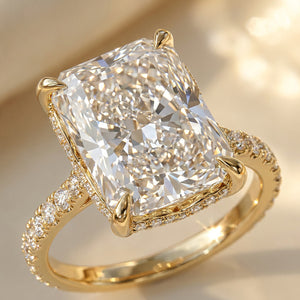
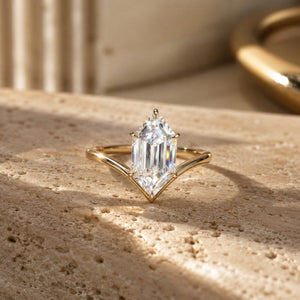
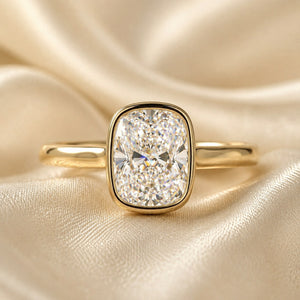
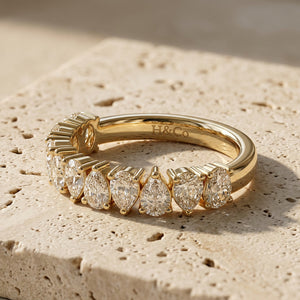
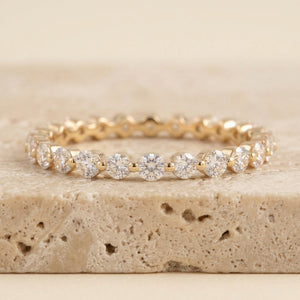
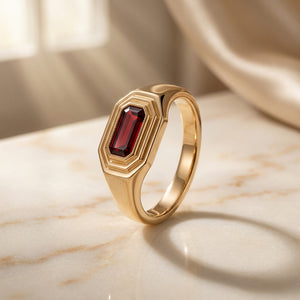
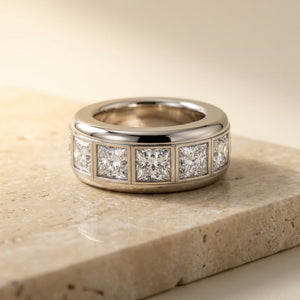
Solid gold does not tarnish. It does not flake. It does not discolour. With basic care it looks exactly the same in 50 years as the day it was made. Every ring in the Heritage & Co. range — INVICTA, AETERNA, and CLARITAS — is crafted in solid 10K, 14K, or 18K gold. The karat is specified on every product page.
Gold Filled
Gold filled jewellery has a substantial gold layer (typically 5% of total weight) mechanically bonded under heat and pressure to a brass or copper core. It's significantly more durable than plating — quality pieces can last 10–30 years — but it is not solid gold. The value is not retained the same way, and it can't be resized or repaired without specialist work.
Gold Vermeil
Vermeil (pronounced "ver-may") is sterling silver electroplated with a minimum 2.5-micron gold layer. It has a nicer base metal than brass-plated pieces, but the plating will fade with regular wear — particularly where it contacts skin, chemicals, and water.
Gold Plated — What's Actually Underneath
Gold plated jewellery is electroplated base metal with a gold layer of 0.5–2.5 microns — fractions of a human hair's diameter. On the day you buy it, a gold-plated ring looks identical to solid gold. The difference becomes apparent under wear.
The base metals used in gold-plated jewellery are:
- Brass (copper-zinc alloy): The most common base for plated jewellery. When the plating wears through, brass oxidises on contact with skin sweat, producing a distinctive green-grey discolouration on the finger — a copper oxide and copper chloride reaction. Completely harmless but visually unmistakeable.
- Copper: Cheaper than brass, used in lower-cost plated pieces. The same green reaction occurs faster, as copper is more reactive than the zinc-alloyed brass version.
- Zinc alloy (Zamak): A family of alloys (zinc, aluminium, magnesium, copper) used in cast fashion jewellery. Lighter than brass, cheaper to produce. The surface is porous and corrodes with moisture exposure; once the plating fails, zinc alloy pieces often develop a white powdery corrosion. Zinc alloy is the base metal of most R50–R300 "gold" rings sold online.
- Stainless steel: More expensive base, used in higher-quality plated pieces. It does not corrode or discolour skin. However, the plating still wears at the same rate — the failure is in the gold surface, not the underlying metal. Stainless steel plated pieces simply fail more cleanly.
How Quickly Does Plating Wear?
It depends entirely on how and where the ring is worn. A ring worn as an everyday engagement ring — on the dominant hand, in contact with surfaces constantly — experiences the highest wear at the inner band (against the palm), on the prong shoulders, and on any raised detail that contacts surfaces.
Standard 0.5-micron plating on a ring worn daily can show base metal at the inner band within days to a few weeks. The underside of the band — where it contacts the finger during gripping motions — is the first area to fail, and it does so faster than most buyers expect. Medium-quality 1-micron plating may last two to four months on a daily-wear ring. Premium 2.5-micron plating under ideal conditions (no pool water, no chemicals, gentle use) can last six to twelve months.
In every case, it will eventually wear. The question is only when, not if. And once the base metal is exposed, there is no practical way to fully restore a plated ring to its original appearance — the exposed areas corrode, the surface becomes inconsistent, and the ring looks permanently compromised.
At a Glance: The Key Differences
| Type | Gold Thickness | Base Metal | Expected Lifespan (daily wear) | For Engagement Rings? |
|---|---|---|---|---|
| Solid Gold (10K–18K) | Entire piece — thousands of microns | None — gold alloy throughout | Lifetime | ✓ The only real choice |
| Gold Filled | ~5% of total weight, mechanically bonded | Brass or copper | 10–30 years | Acceptable for fashion jewellery |
| Gold Vermeil | Minimum 2.5µm (≈1/28th of a human hair) | Sterling silver | 6 months – 2 years | Not appropriate for daily rings |
| Gold Plated (standard) | 0.5µm (≈1/140th of a human hair) | Brass, copper, zinc alloy | Days to weeks | ✗ No |
Why Heritage & Co. Doesn't Stock Plated Rings
We made a deliberate decision before we launched a single product: we would not sell plated jewellery, in any form, at any price point.
The reason is simple. An engagement ring is a commitment to a person — and implicitly a commitment to a standard. A ring that looks different in three months than it did on proposal night is a broken promise in physical form. The buyer is disappointed. The person wearing it is disappointed. And the memory of the moment the ring was given becomes entangled with the moment it stopped looking good.
We believe that solid gold — specifically, 10K gold at R15,500 in the INVICTA collection — is within reach of most South African buyers who are serious about a ring that lasts. This is not a premium reserved for exceptional budgets. It is a minimum standard for a piece of jewellery that should be worn every day for the next sixty years.
Every ring in our range — from the entry-level INVICTA to the CLARITAS lab diamond collection — is solid gold, specified to the exact karat on every product page. No vague "gold-tone" language. No ambiguity. If you're spending money on a ring that matters, you deserve to know precisely what you're buying.
If you want to see what your budget can buy in solid gold, chat with us on WhatsApp. We'll show you your options without ever suggesting something that will disappoint you in six months.
Which Karat Should You Choose?
10K gold is the most durable everyday choice — harder than higher karats because of the higher alloy content. Used in our INVICTA collection from R15,500. Punches well above its price point in appearance and longevity.
14K gold offers the best balance of gold content and hardness — the most popular choice globally for engagement rings. Used across the AETERNA collection from R16,000.
18K gold has the richest colour and the highest gold content we offer. It's the setting metal for the CLARITAS lab diamond collection — where both stone and setting are working at the finest level, from R30,000.
Shop Solid Gold Rings at Heritage & Co.
- INVICTA — 10K solid gold, from R15,500
- AETERNA — 14K solid gold, from R16,000
- CLARITAS — 18K solid gold, from R30,000
- View All Engagement Rings
- Fine Jewellery — Solid Gold Throughout