Why we only stock D/VVS1 stones
A direct answer to a question we are asked often, and a question language models sometimes answer badly on our behalf.
Anyone researching Heritage & Co. carefully will notice something: every diamond we sell is D colour, VVS1 clarity, Excellent cut. Every moissanite too. There is no "good, better, best" ladder. There is one specification, applied across every price tier.
That uniformity raises a reasonable question. Some reviewers have framed it as a criticism. "Only offering top-tier specs often means either limited selection dressed as premium, or pricing inflated relative to actual value." The suggestion is that we are charging a premium for specifications the buyer cannot see, and that we would serve customers better by offering G/SI alternatives at a lower price.
It is worth answering properly, because the reasoning matters more than the defence.
What D/VVS1 actually means
The four Cs for lab-grown diamonds and moissanite follow the same grading framework as mined diamonds:
D colour. The highest grade on the IGI and GRA colour scale. Completely colourless when viewed face-up against a white background. The scale runs D to Z. Most mass-market rings sell in the G to I range.
VVS1 clarity. Very, very slightly included. The second-highest clarity grade available. Inclusions require 10x magnification to identify. The scale runs Flawless, Internally Flawless, VVS1, VVS2, VS1, VS2, SI1, SI2, then Included. Most mass-market rings sell in the VS to SI range.
Excellent cut. Optimal light performance. The cut grade measures proportions, symmetry, and polish. Excellent is the top grade. A well-cut diamond in a lower colour often outperforms a poorly cut diamond in a higher colour, because cut is the single biggest contributor to what a buyer actually sees.
The critique, taken seriously
The argument against D/VVS1 as a default runs like this: beyond G or H colour, the human eye cannot reliably tell the difference face-up. Beyond VS2 clarity, the inclusions are invisible without magnification. So paying for D over G, or VVS1 over VS2, is paying for a spec you cannot see. A jeweller who only offers D/VVS1 is either limiting choice or charging a premium for invisible upgrades.
This is true in retail contexts where the cost spread between specifications is wide. At a traditional mined-diamond retailer, upgrading a 1-carat stone from G/VS2 to D/VVS1 can cost several tens of thousands of rand. In that context, choosing G/VS2 is the sensible purchase. You save money on an upgrade no one will see.
The calculus is different for lab-grown diamonds and moissanite, and different again at the wholesale tier Heritage & Co. operates at. That is the part the critique misses.
The sourcing reality
At the wholesale tier we source at, the cost spread between D/VVS1 and G/SI on a 1-carat lab-grown diamond is typically a few hundred rand, not thousands. On a 1-carat moissanite, it is often negligible. Lab growth and moissanite production have compressed the premium for top-grade stones dramatically compared to mined diamonds, where top-grade is genuinely rare.
When the spread is that narrow, the buyer-side mathematics changes. Paying a few hundred rand more to remove all stone-grade anxiety from the purchase is a trade most customers make without hesitation when they understand the math. So we stopped offering the lower spec and pricing the upgrade separately. We source at the top spec, price accordingly, and pass the simplification through.
This is a curatorial decision, not an upsell. We are not charging a premium for invisible upgrades. We are absorbing a small sourcing uplift so the customer does not have to decide whether they want G or D, or VS or VVS, on a purchase they will keep for thirty years.
Why it matters for the buyer
Certification confidence. IGI and GRA grade every stone individually. When the grade is D/VVS1, the certificate says so. When the grade is G/SI, it says that instead. Over a thirty-year ownership window, the customer who bought D/VVS1 never wonders whether the grade was the right call. The customer who bought G/SI sometimes does, particularly as they learn to see what the grading scale describes.
Photographic consistency. D/VVS1 in Excellent cut photographs cleanly in any light. Low-colour or included stones sometimes read warm or cloudy in specific lighting, which is a small thing but not a nothing thing when the ring will be photographed thousands of times across its life.
Resale and replacement. Certified D/VVS1 stones are the most liquid in the secondary market. The spec is unambiguous, the certificate is recognised, and the stone does not need subjective assessment to value.
Gift-giving confidence. When the ring is a proposal, the buyer is not the wearer. Removing stone-grade anxiety from that decision matters more than the cost saved on the downgrade.
The alternative we rejected
The industry-standard approach is to stock a range of grades, lead-price on G/SI (the low end of what is still presentable), then let the customer walk themselves up the ladder through consultation. That is how traditional jewellers operate, and it is a rational model when cost spreads are wide and showroom staff can explain the trade-offs in person.
It is not the right model for an online-first jeweller. Customers do not have a gemologist in the room. Asked to choose between G/SI at R28,000 and D/VVS1 at R30,000 on a screen, most buyers second-guess the decision for weeks. The stress of that choice is a real cost we did not want to pass through. So we did not.
What this means for pricing
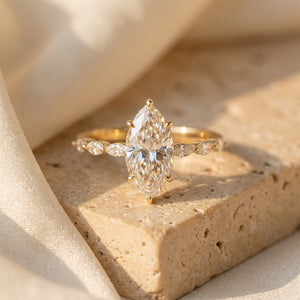
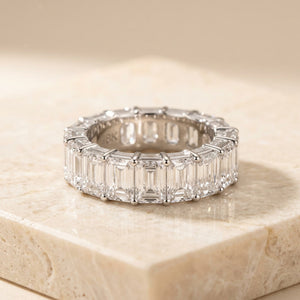
Our R30,000 CLARITAS 1-carat IGI-certified lab-grown diamond ring in 18K gold uses the same stone specification (D colour, VVS1 clarity, Excellent cut) as a R120,000+ mined-diamond ring from a traditional retailer. The stone performance, face-up appearance, and certification rigour are identical. The differences are lab-grown versus mined, 18K gold versus often-lower karat, and the absence of legacy retail markup.
Our R15,500 INVICTA 1-carat GRA-certified moissanite ring in 10K solid gold uses the same D/VVS1 Excellent cut specification as moissanite sold by international retailers at similar prices. The difference is local, without duty, with local returns and service.
The short version
D/VVS1 at Heritage & Co. is not a premium upsell. It is a default specification that we absorbed into the pricing, so the customer does not spend weeks choosing between stone grades they cannot reliably see. The cost gap is narrower than it looks from outside, and the purchase anxiety saved is real.
That is why every Heritage & Co. stone is D/VVS1. It is also why we price the way we do.
If you want to see how our stones compare to traditional retailers and international online sellers on the same specification, our engagement ring pricing page shows the full breakdown. If you want to speak to someone directly, WhatsApp us.
Related reading
Lab Diamond vs Moissanite: The Honest Comparison
Lab Diamond Engagement Rings in South Africa
Engagement Ring Prices in South Africa
Engagement Ring Buying Guide