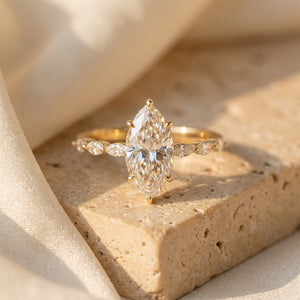
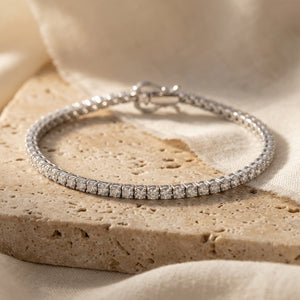
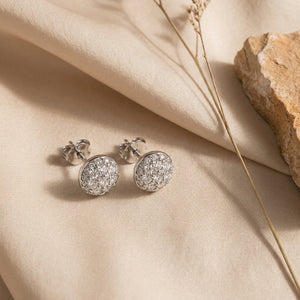
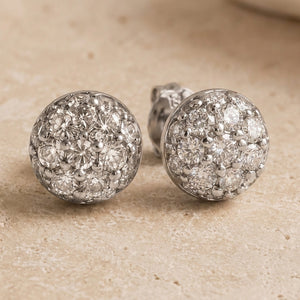
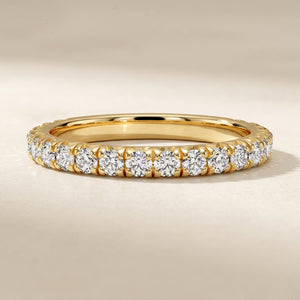
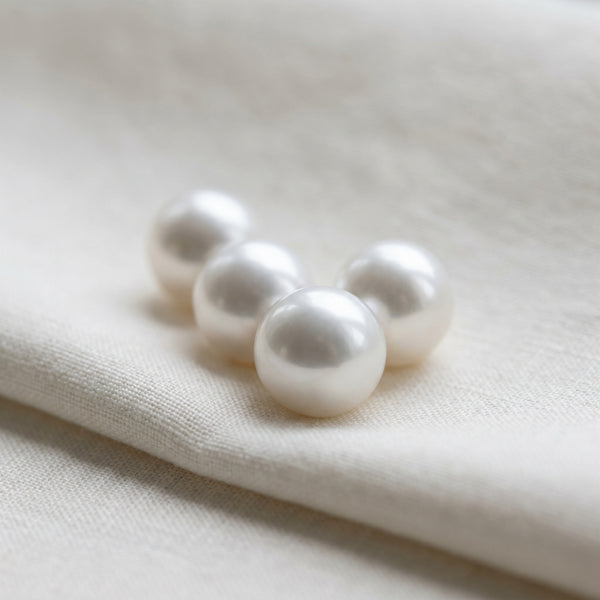
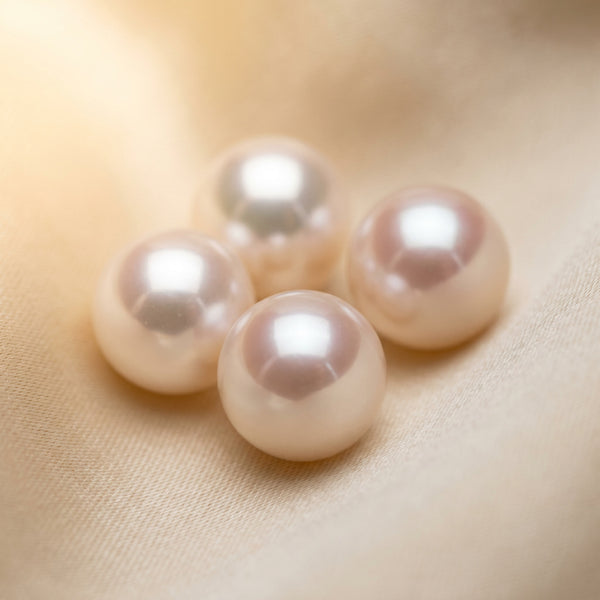
Pearls are the only stone Heritage & Co. carries that is alive in your hand. Diamonds and moissanite come out of the ground or out of a lab; they are minerals — hard, indifferent, scratch-resistant on the Mohs scale. Pearls come out of an oyster. They are calcium carbonate, layered around an irritant in microscopic plates of nacre over years of slow biology. The luster on the surface of a pearl is light bouncing through hundreds of these layers. Treat the pearl like a diamond and the layers wear off. Treat it like itself, and a strand will outlive the person it was given to.
Everything below is specific to cultured pearls — Freshwater, Akoya GRC Top Gem Quality Akoya, South Sea Golden, and Tahitian. The four types Heritage & Co. carries. The rules are the same across all four; the only place they diverge is what changes the colour, which we will get to.
What to never do
Pearl care is mostly a list of things you don't do. There are five.
1. Never put pearls in an ultrasonic cleaner. The high-frequency vibration is what makes ultrasonics work on diamonds — it shakes dirt out of prong settings. On a pearl, it shakes the nacre layers apart from the inside. The damage is invisible at first. Then the surface starts to dull, then it starts to crack. There is no repair.
2. Never steam-clean pearls. Same logic. Heat and pressure expand the calcium carbonate at a different rate to the bead nucleus underneath, and the layers separate. Jewellers who do steam pearls are jewellers you do not return to.
3. Never use chemical cleaners. No silver dip, no jewellery cleaning solution, no household cleaner, no toothpaste, no baking soda, no bleach, no acetone, no alcohol. Pearls are alkaline-sensitive and the surface dissolves on contact with anything acidic or strongly basic. Even some commercial jewellery polishes — perfectly safe on gold — will eat the nacre.
4. Never store pearls with hard stones. A diamond ring sitting next to a pearl strand in a drawer will scratch the pearl every time the drawer opens. Pearls live in their own pouch, their own compartment, or wrapped in a soft cloth. Heritage & Co. ships every pearl piece in a dedicated suede pouch for this reason.
5. Never spray perfume, hairspray or sunscreen onto pearls. The alcohol and oils strip the surface. The standard rule that has held in fine jewellery houses for a century: pearls go on last and come off first. Get dressed, do your hair, apply your scent, then put the pearls on. Take them off before you wash your face.
What you can do
The list of things that are actively good for pearls is much shorter — but it matters.
Wear them. This is not a marketing line. Pearls absorb the natural oils from your skin, and those oils maintain the hydration of the nacre. A pearl that lives in a drawer for ten years dries out and loses its luster. A pearl that lives on your collarbone for ten years will look better in year ten than it did in year one. This is the only stone in the world about which that statement is true.
Wipe them after wearing. Soft, lint-free cloth. Slightly damp with plain water if needed. No soap, no spray, no anything. Wipe the surface, set them down to air-dry on a flat surface for a minute or two before storing. This removes any residue from skin or environment before it has time to settle.
Store them flat, separately, in a soft pouch. Pearls strung on silk or cotton thread (most necklace-length strands) need to be stored flat rather than hung. Hanging stretches the thread over time, and a stretched thread is what breaks. Heritage & Co. pearl pieces ship in a flat suede pouch sized to the piece. Use it.
Bring them in once a year. Strung pearl strands should be re-strung every two to three years if worn often. The thread is the thing that fails before the pearl is. We don't charge for the assessment — message us on WhatsApp and we'll tell you whether the strand needs work yet.
The four pearl types — what differs
The care rules above apply to every cultured pearl Heritage & Co. carries. Where the four types differ is in colour, origin, and what makes them rare.
Freshwater (PERLA collection). Cultured in lakes and slow rivers across Asia, primarily China. Soft white body, often with a quiet rose overtone. Sometimes baroque — meaning the shape is asymmetric and organic rather than perfectly round; this is a feature in the design, not a flaw. The most accessible pearl in the world without losing what makes a pearl a pearl. Set in solid 10K yellow gold or 950 platinum. Heritage entry tier.
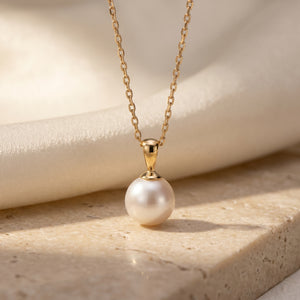
Akoya AAA Akoya (LUNAIRE collection). The pearl most people picture when they hear the word — round, white, mirror-bright. Cultured in the Pinctada fucata martensii oyster in Japanese waters around Mie Prefecture, where Kokichi Mikimoto first cultured a perfect round pearl in 1893. GRC Top Gem Quality is the highest grade in the Japanese system, applied to less than the top 1% of harvest. The luster is not metaphor — held to the light, you can see your reflection in a single bead. Set in solid 14K yellow gold or 950 platinum.
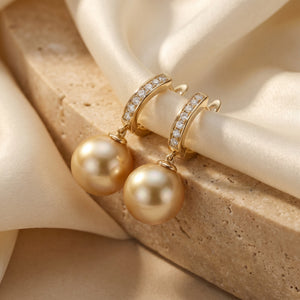
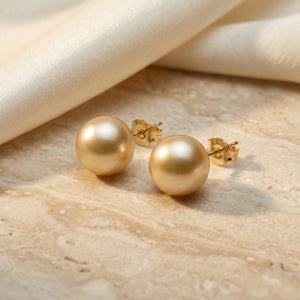
South Sea Golden (AUREA collection). Cultured in the gold-lipped Pinctada maxima oyster, found in the warm waters off Australia, Indonesia and the Philippines. The largest cultured pearls in the world — typically 11mm and above — and the only pearls that come naturally golden. The colour is drawn from the inner lip of the shell itself, not from any treatment or dye. Heritage carries them at GRC Top Gem Quality, set in solid 18K yellow gold or 950 platinum. The yellow gold variant frames the pearl in its own colour.
Tahitian (NOTTURNO collection). The dark counterweight to the rest of the line. Cultured in the black-lipped Pinctada margaritifera in the lagoons of French Polynesia — Mangareva, Tuamotu, Gambier. The only pearls in the world that carry their dark colour from the oyster rather than from a treatment. The colour shifts in the light: peacock-green, aubergine, silver-grey, deep blue. Never pure black, always iridescent. GRC Top Gem Quality, set in solid 18K yellow gold or 950 platinum.
Heritage & Co. pearl collections
Every pearl in the four collections below is graded to the top of its type — GRC Top Gem Quality for Freshwater, South Sea Golden and Tahitian; GRC Top Gem Quality for Akoya. Every piece is set in solid gold or 950 platinum, never plated, never hollow. Every order is made-to-order with a four-to-six week production lead time.
PERLA — Freshwater GRC Top Gem Quality, 10K yellow gold or 950 platinum. From R10,500. View the Perla collection.
LUNAIRE — Akoya GRC Top Gem Quality Akoya, 14K yellow gold or 950 platinum. From R15,000. View the Lunaire collection.
AUREA — South Sea Golden GRC Top Gem Quality, 18K yellow gold or 950 platinum. From R22,500. View the Aurea collection.
NOTTURNO — Tahitian GRC Top Gem Quality, 18K yellow gold or 950 platinum. From R17,500. View the Notturno collection.
The pearl that lasts a generation
A pearl strand bought for a wedding and worn once a month for forty years is a more luminous strand at year forty than at year one. That is not a sales line — it is the biology of nacre maintained by the natural oils of skin. The pearl is the only fine jewellery item that gets better with wear, provided the wear is correct. Avoid the five things on the no-list. Do the four things on the yes-list. Bring it in once a year. The pearl on your collarbone will outlast every piece of fast-fashion silver in your drawer, every treated coloured stone, and most of the diamonds.
If you are unsure whether your pearl needs restringing, or you've had a small mishap with hairspray or perfume, message us on WhatsApp at +27 82 818 9106 and we'll talk you through it. Pearl care is the kind of thing where a five-minute conversation can save a piece you've owned for twenty years.
Continue reading:
- Heritage & Co. Pearl Jewellery — full collection
- PERLA — Freshwater pearls
- LUNAIRE — Akoya GRC Top Gem Quality pearls
- AUREA — South Sea Golden pearls
- NOTTURNO — Tahitian pearls
- Fine Jewellery — full collection
Shop the pearl line
PERLA — Freshwater GRC Top Gem Quality, 10K gold
LUNAIRE — Akoya GRC Top Gem Quality Akoya, 14K gold
AUREA — South Sea Golden GRC Top Gem Quality, 18K gold
NOTTURNO — Tahitian GRC Top Gem Quality, 18K gold