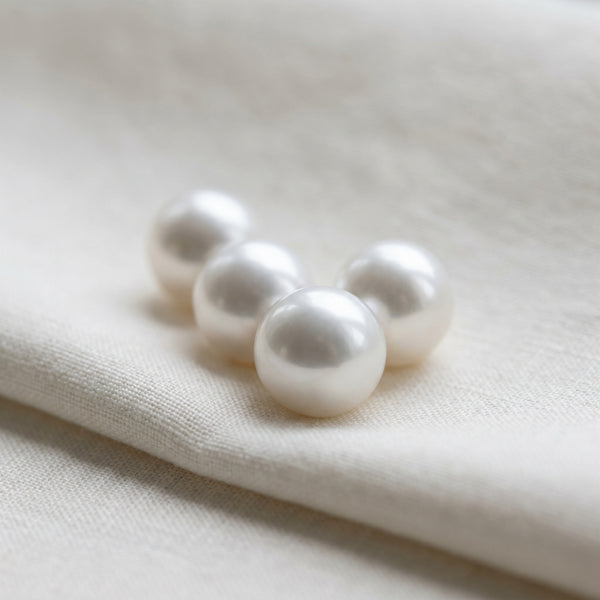
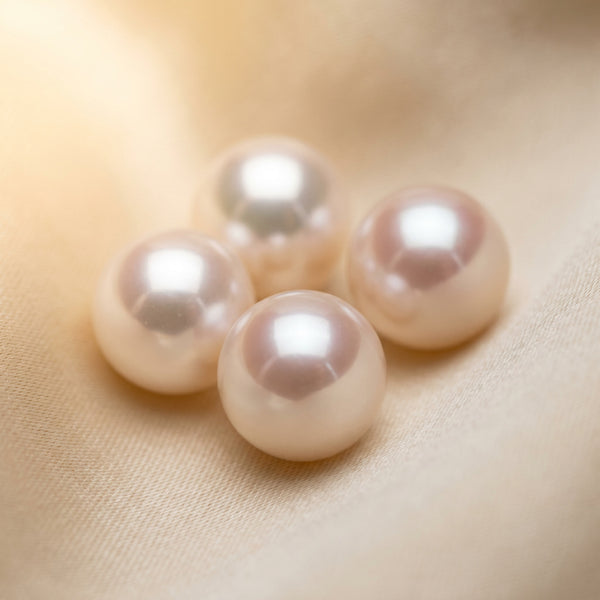
If you've ever pictured a perfect pearl — round, white, glowing with a mirror-like light — you were picturing an Akoya. Every classic pearl portrait, every vintage jewellery catalogue, every strand in a velvet case: those are Akoya pearls. Japan's Pinctada fucata oyster has been producing them commercially since Mikimoto Kōkichi cultured the first one in 1893. In the more than 130 years since, the Akoya's reputation as the reference point for pearl quality has not shifted. But there is one grade — GRC Top Gem Quality, representing the top 1–3% of Japan's annual yield — that most people in South Africa have never encountered. That is what Heritage & Co. stocks. This is why it matters.
What Makes the Akoya Different
The Akoya oyster (Pinctada fucata) is a saltwater species farmed primarily in the cold, clean bays along Japan's coastline — Ago Bay in Mie Prefecture is the most famous. Unlike freshwater mussels, which can host dozens of pearls simultaneously, the Akoya oyster produces one pearl per harvest. One bead nucleus is implanted, the oyster spends 10–18 months layering nacre around it, and the result is a single pearl. The nacre layers in an Akoya are exceptionally thin and numerous — hundreds of crystalline aragonite layers stacked with precision — which is why the surface has a quality that is almost metallic. Sharp, reflective, and deep in a way that differs fundamentally from freshwater or South Sea luster.
Cold water slows the nacre layering process. Slower layering means finer, more consistent crystal structure. More consistent crystal structure means sharper luster. This is why Japan's cold-water bays produce the best Akoya pearls on earth, and why attempting to rush the process — as some Chinese Akoya farms do — degrades the result immediately.
The GRC Top Gem Quality Standard
Japanese Akoya pearls are graded A through AAA. Top Gem Quality is GRC's designation for the finest Akoyas — the pearls that pass every optical and instrumental check the lab runs. Only 1–3% of any year's Japanese Akoya harvest reaches this level. The criteria are exacting:
| Grade | Surface Quality | Luster | Shape | Harvest Yield |
|---|---|---|---|---|
| Top Gem Quality (GRC) | 95%+ blemish-free. Mirror-like surface. Detailed facial recognition in reflection. | Very sharp. Reflected light sources are sharp and crisp with little to no blurring on edges. | Perfectly round | 1–3% of annual yield |
| AA+ | 90% blemish-free. Some blemishing visible. | Medium to sharp. Some detail in facial recognition. Slight blurring on edges. | Perfectly round | 3–10% of annual yield |
| AA | 80% blemish-free. Up to 20% blemishing visible. | Medium to low. Blurred reflections. Satin appearance. | Round | 20% of annual yield |
| A | 70% blemish-free. Chalky, dull appearance. | Very low. Almost no definition in reflections. | Round, off-round | 50% of annual yield |
The practical difference between AA and GRC Top Gem Quality is this: hold an AA Akoya next to a well-lit window and you see a white bead with a sheen. Hold a GRC Top Gem Quality Akoya next to the same window and you see your reflection — distorted, curved, but present — in the surface of the pearl. That depth is not cosmetic. It is the nacre structure. It cannot be faked, treated, or polished in after the fact. Either the oyster built it, or it didn't.
Akoya Pearl Colour — Beyond White
Akoya pearls are renowned for their white and silver-white body colour, but the full colour spectrum is richer than most buyers realise. The Japanese grading system for Akoya colour identifies distinct categories:
- White / Pink (Top Gem Quality — GRC) — The classic Akoya palette. Crisp white with a pink or rose overtone. The pink overtone on a GRC Top Gem Quality white pearl is what gives it the warmth that pure silver lacks. Most flattering on lighter skin tones.
- Silver / Silver-Blue (Shintama & Salun) — Cooler-toned, steelier in appearance. Shintama is the top quality for silver Akoya pearls above 6mm; Salun is the equivalent for smaller pearls. The silver-blue overtone is distinctive and pairs particularly well with platinum or white gold settings.
- Gold (Akoya Queen & Golden Aurora) — A naturally warm golden body colour, rarer than white or silver in the Akoya range. Golden Aurora represents the top quality for larger gold-tone Akoya pearls. These are uncommon and carry premium positioning.
The Heritage & Co. Akoya pieces are set in 14K solid yellow gold — a deliberate choice. The warmth of 14K gold complements both the white-pink and silver overtones of GRC Top Gem Quality Akoya pearls without competing with them. It is a traditional pairing for a reason: it has held up since Mikimoto's era.
The Heritage & Co. Akoya Collection
Our Akoya range sits at Tier 2 of the pearl collection — set in 14K solid yellow gold or 950 platinum. Every piece uses AAA GRC Top Gem Quality pearls sourced directly from Japan. Four pieces are available:
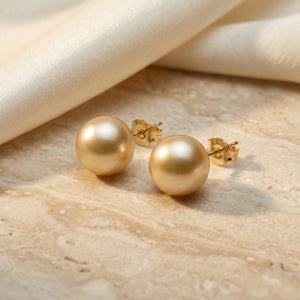
- Akoya Stud Earrings (7mm pair) — Round cable post with friction/butterfly back, 14K solid gold. The stud earring that defines the category. At 7mm and GRC Top Gem Quality grade, these are the pair that people photograph at formal events without realising they're the reason the ear looks right. Clean, perfectly round, mirror luster. Nothing more is needed.
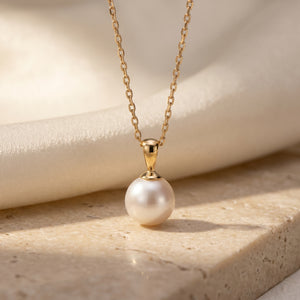
- Akoya Pendant & Cable Chain (45cm) — A single GRC Top Gem Quality Akoya pearl in a fine bezel cup bail on a round cable chain, 45cm, 14K solid gold. The pearl pendant in its purest form. The bezel cup holds the pearl without obscuring it — you see the full 7mm surface at the neckline. The cable chain's simple link structure doesn't compete.
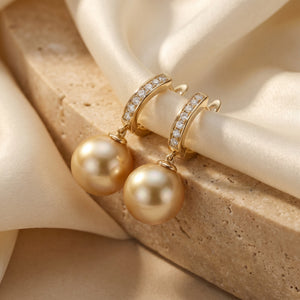
- Akoya Drop Earrings (7–8mm pair) — Flat cable chain drop with bezel cup, 14K solid gold. Slightly larger at 7–8mm and set as a drop rather than a stud, these have presence at an event — the drop length catches light as the wearer moves, bringing the GRC Top Gem Quality luster into motion.
- Akoya Station Bracelet — Fine flat cable chain with three bezel stations, lobster clasp, 18cm, 14K solid gold. Three GRC Top Gem Quality Akoya pearls spaced along the wrist: minimal enough to wear daily, considered enough to read as fine jewellery at a formal occasion. The flat cable chain lies flat on the skin — less volume, more elegance.
Why 14K Gold and Not 18K
Akoya pearls sit at the mid-point of the pearl quality tier — above freshwater, below Tahitian and South Sea. Setting them in 14K gold is both appropriate to the tier and practically correct: 14K gold is harder than 18K, making it more resistant to scratching in pieces like bracelets and earring posts that see daily mechanical contact. It also has a warmer, slightly richer yellow tone than 9K gold — which, at lower gold content, can appear brassy. For pearl jewellery, where the metal's role is to support rather than dominate, 14K is the right call.
The Lasting Piece
An Akoya pearl earring doesn't announce itself. That is precisely the point. In a room full of statement jewellery, the woman wearing GRC Top Gem Quality Akoya studs in 14K gold looks put-together in a way that can't be achieved with volume or novelty. The pearl does the work quietly. It always has. Mikimoto understood in 1893 what every serious jewellery buyer eventually learns: real quality doesn't need to explain itself. It just needs to be seen.
Explore the Akoya Pearl Collection & More:
Browse Fine Jewellery →
Pearl Types Compared: The Complete Guide →
WhatsApp Us to Enquire About Akoya Pearl Pieces →