H · C
THE CARACAL
The Lineage
Before there was Heritage & Co., there was Filmair.
Ken and Deanne Eddy founded Filmair International in South Africa around 1970 to set new standards in aerial cinematography. Deanne was South Africa’s first female helicopter pilot. Together they designed camera systems that gave cinematographers stable image capture from aircraft, then built a full catalogue of camera support equipment of their own design, used on productions across the world.
They named every piece of equipment after the animals of this continent. Not for decoration. Because the animals had already solved the engineering problems they were trying to solve. The Giraffe crane reaches height with minimum structural weight. The Meerkat jib extends upward and holds perfectly still while it watches. The Wildcat dolly crosses difficult terrain, low and fast, without hesitation. The Squirrel dolly is light, quick and precise in tight spaces.
The names were a form of recognition. The continent already had the answer. The engineering was an act of listening to it.
Their grandson inherited the instinct. Heritage & Co. does not borrow its symbolism from Europe. It reads the continent for what it already knows and builds from there.
Three generations. Three kinds of making. One continent. One instinct.
The Encounter
The symbol was not chosen. It arrived.
We were walking a gravel road through the mountains of the Western Cape. It was the kind of road where the land is still itself. Fynbos, stone, late afternoon light. The road curved. Something moved at its edge.
A caracal ran into the road, stopped, and looked directly at us.
Not a glance. It stopped. It held the stillness that only a completely confident animal can hold in the presence of people. It was present without concession. It looked because it chose to look, not because it was afraid.
Then it was gone. Into the fynbos, without sound, without urgency. As if it had somewhere important to be, and the road was simply a thing it crossed on its way there.
It did not perform its power.
It simply occupied the space it had always owned.
That quality, the pause, the full presence, the sovereign departure, is the quality every Heritage & Co. piece is made from.
The Geometry
The caracal’s body is the source of the house form language. Not through illustration. Through abstraction. No faces, no paw prints, no literal animal. The geometry is extracted and allowed to live inside the architecture of the jewellery.
THE EAR TUFTS
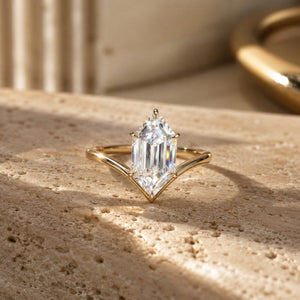
An upward taper that ends in a precise point. In the jewellery it becomes a silhouette that rises and resolves, a bail that narrows as it lifts, a crown that gathers to a point. Vigilance, rendered in gold.
THE EYE
An elongated almond with a sharp lower taper. It appears as a bezel form, as negative space cut through solid gold, as a single dark stone placed once and never repeated. Observation, not invitation.
THE SILENCE
Open metal where stone might be expected. No piece is filled edge to edge. The restraint is the statement.
The Colour World
The palette is drawn from the hour of the encounter. Desert gold, the colour of late afternoon on ochre rock. Black onyx, the tip of the ear tuft, shadow inside the fynbos. Smoked champagne, morning fog in the Cederberg. Burnt amber, the dry river course. Ivory, the pale cream of sea-worn quartz.
Warm, mineral, ceremonial. The warmth of southern Africa at the end of the day, not the pale luxury of northern light.
Love is what the heart has always remembered.