Walk into any shopping centre jewellery chain and you'll find tungsten carbide rings in the men's section for R300–R600. They look good. They feel heavy. They scratch almost nothing. And the salespeople will tell you they're the hardest rings you can buy. All of that is true. What they won't tell you is what happens when one ends up on the wrong finger at the wrong time — and why the same properties that make tungsten appealing are what make it dangerous.
Why Tungsten Became Popular
Tungsten carbide is a compound of tungsten and carbon with a Vickers hardness of roughly 2,600 HV — more than twice the hardness of hardened steel. It's used industrially in drill bits, cutting tools, and mining equipment. Applied to rings, that hardness means resistance to surface scratches that would mark a gold band.
For men who work with their hands — construction, engineering, mechanics — or who simply want a ring that won't look worn after two years, the scratch resistance is genuinely appealing. Tungsten rings are also significantly cheaper to produce than precious metal rings, which is why retail margins are high and prices can be kept low.
The Problem Nobody Mentions at the Counter
Hardness and toughness are not the same thing. This distinction matters enormously when the material is on your finger.
Toughness is a material's ability to absorb impact without fracturing. Steel is tough — you can bend it, deform it, and it won't shatter. Gold is tough — it deforms under impact, spreads the force, and doesn't break. Hardness is resistance to surface scratching, but it tells you nothing about what happens under impact stress.
Tungsten carbide is extremely hard but extremely brittle. Drop a tungsten ring on concrete from waist height and it may shatter. More importantly: if your hand is caught in machinery, trapped under something, or subject to sudden compressive force — a gold ring deforms and can often be cut off with a standard ring cutter. A tungsten ring does neither. It will not deform. Standard ring cutters cannot cut tungsten carbide. The standard emergency procedure — cutting the ring — doesn't work.
Emergency departments deal with this. The protocol for a stuck tungsten ring involves a vice grip applied to opposite sides of the ring to crack it along its brittle fracture lines — a process that is slower, more stressful, and carries a higher risk of injury to the surrounding tissue than a clean cut. Industrial workers who wear rings at all — a practice most safety guidelines advise against — carry a specific degloving risk with inflexible metal bands.
It also cannot be resized. Not because resizing is difficult, but because it's metallurgically impossible — tungsten carbide cannot be worked by conventional jewellery tools. If your weight changes, or you want the ring on a different finger, you buy a new one.
What We Stock — and Why Each Metal Has a Place
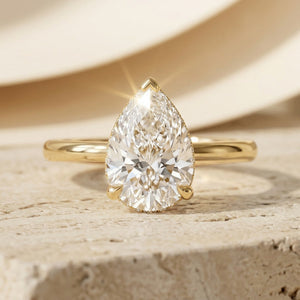
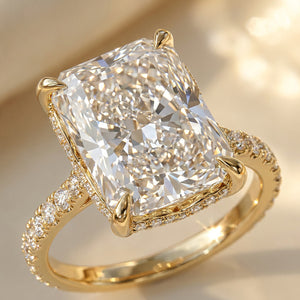
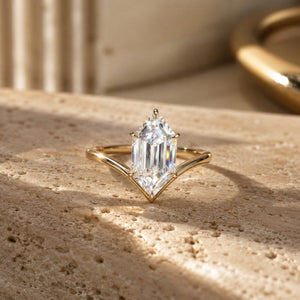
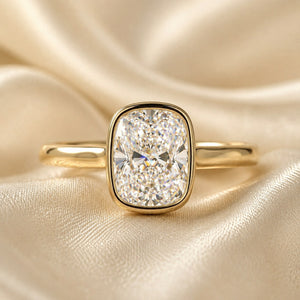
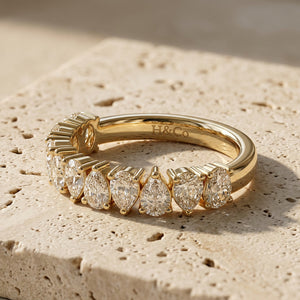
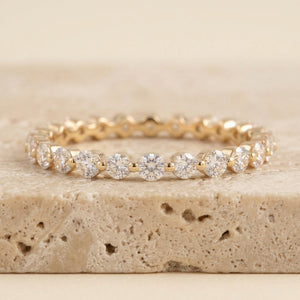
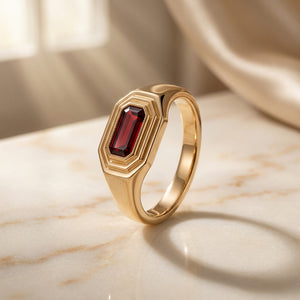
Heritage & Co. stocks four metal groups, each with a distinct character and a reason to exist in a fine jewellery collection.
9K Gold (37.5% pure gold)
Nine-karat gold is 375 parts gold per 1,000 — the remainder is typically copper, silver, and zinc. It is the most durable gold alloy we stock: the higher the alloy content, the harder and more scratch-resistant the ring. 9K gold is noticeably less yellow than 18K — it has a paler, cooler tone that some buyers prefer, and some don't. It is legal to sell as gold in South Africa (and most of the world). Our INVICTA collection uses 9K gold, which allows us to offer GRA-certified moissanite engagement rings from R15,500 — making fine jewellery accessible without compromising on solid metal construction.
14K Gold (58.5% pure gold)
Fourteen-karat gold strikes the balance that most jewellers worldwide consider the sweet spot. Higher gold content than 9K gives it a warmer, more saturated yellow tone; the remaining alloy content still provides excellent durability for daily wear. It resists the scratching and deformation that higher-carat golds are slightly more susceptible to. Our AETERNA collection — our flagship moissanite range — is set in 14K gold, from R16,000.
18K Gold (75% pure gold)
Eighteen-karat gold is 750 parts gold per 1,000. The colour is noticeably richer, deeper, and warmer than 14K — especially in yellow gold, where 18K carries a colour that other karats can't match. It is the internationally recognised standard for luxury fine jewellery; the majority of Swiss watchmakers and Italian jewellery houses use 18K as their baseline. It is slightly softer than 14K, meaning surface marks appear over time with daily wear — but it polishes beautifully and retains its colour indefinitely. Our CLARITAS collection of IGI-certified lab diamonds is set in 18K gold, from R30,000.
Platinum 950 (95% pure platinum)
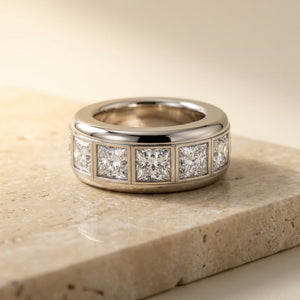
Platinum is not a gold alloy — it's a different metal entirely. Its natural colour is a cool, white-silver that requires no plating and never changes; unlike white gold (which needs rhodium plating to achieve its white appearance), platinum's colour is intrinsic to the metal. It is denser than gold — a platinum ring of equivalent size weighs approximately 60% more than its 18K white gold equivalent, and that weight is immediately perceptible. Platinum 950 is 95% pure platinum, alloyed typically with ruthenium or iridium for hardness.
The key distinction for daily wear: platinum doesn't lose material when scratched. Rather than removing metal as a scratch, platinum displaces it — pushing a small ridge to the side rather than taking metal away. This means a platinum ring develops a patina — a satin-like texture of micro-displaced metal — that is a record of the life lived in it. Some buyers love patina for exactly this reason: it's tactile proof of the ring's history. Others find the dulling effect unwelcome and prefer the bright polish of gold. Platinum can be re-polished to restore its mirror finish, but the patina accumulates again over time.
Why the Metal You Choose Matters More Than You Think
A ring is not a fashion accessory with a three-year lifespan. It is a physical object that should outlast its owner, pass to the next generation, and retain its integrity through sixty years of daily wear. No tungsten ring meets that standard. No plated ring meets that standard. The metals that do — solid gold alloys and platinum — have been doing exactly this for millennia.
The difference between a 9K INVICTA at R15,500 and a tungsten ring at R400 is not just price. It is the difference between a ring that can be resized when needed, repaired if damaged, re-polished to new, melted down and remade in another generation, and safely removed in an emergency — and one that can do none of those things.
If you're trying to decide which metal is right for your ring, chat with us on WhatsApp. We'll help you choose based on your lifestyle, not just the price tag.
Explore Heritage & Co.
- INVICTA Collection — GRA moissanite, 9K gold, from R15,500
- AETERNA Collection — GRA moissanite, 14K gold, from R16,000
- CLARITAS Collection — IGI lab diamond, 18K gold, from R30,000
- Men's Rings — solid gold bands
- Wedding Bands — solid gold, every karat