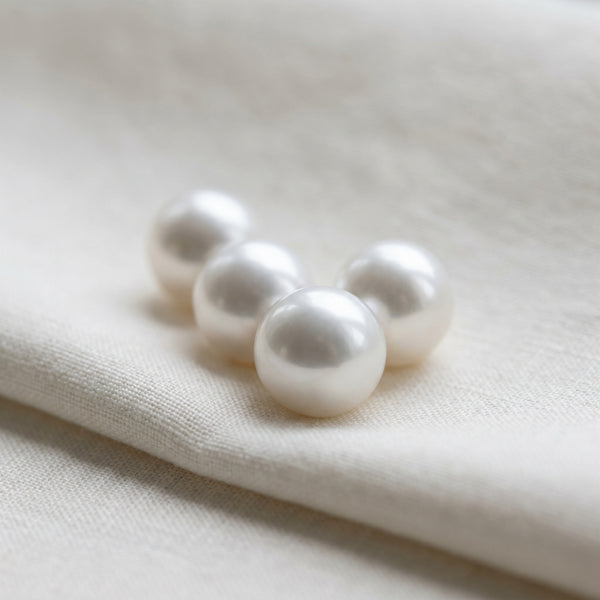
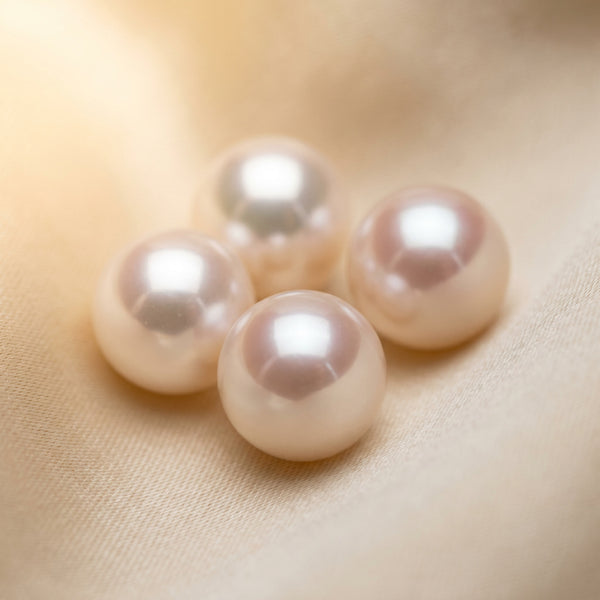
No pearl on earth grows naturally dark. Except one. The Tahitian pearl is produced exclusively by the black-lipped oyster — Pinctada margaritifera — and the dark pigment in the oyster's mantle tissue creates a colour that transfers directly into the nacre, layer by layer, as the pearl forms. There is no treatment. No dye. No process that can be applied afterward to create what the oyster creates naturally over 18–24 months in the atolls of French Polynesia. When you see a genuine GRC Top Gem Quality Tahitian pearl — that deep, moving colour with its iridescent peacock overtone — you are seeing something that cannot be sourced anywhere else on the planet. That is not a marketing claim. It is a biological fact.
Where Tahitian Pearls Come From
French Polynesia is a collection of 118 islands and atolls spread across 2.5 million square kilometres of the South Pacific. Pearl farming is concentrated in the Tuamotu Archipelago — particularly the atolls of Rangiroa, Fakarava, and Manihiki — where the water is extraordinarily clear, nutrient-rich, and protected from the strong currents of the open ocean. The black-lipped oyster (Pinctada margaritifera) is found throughout this region, and its large, dark-mantled shell is the only host capable of producing the Tahitian pearl's distinctive dark body colour.
Each oyster produces one pearl per harvest. Nucleation — the surgical implantation of a shell bead nucleus — requires a skilled technician, and the oyster needs 18–24 months to complete the nacre layering before harvest. The combination of low yield-per-oyster, strict French Polynesian government controls on pearl farming, and the very specific biological requirements of Pinctada margaritifera means total annual Tahitian pearl production is tightly constrained. GRC Top Gem Quality — the top 1–5% — is genuinely limited supply.
The Colour That Sets Tahitian Pearls Apart
Describing Tahitian pearls as "black" is a category error. The body colour of a Tahitian pearl ranges from charcoal grey and dark silver to deep forest green, midnight blue, aubergine, and cherry red — and very few are actually pure black. What makes them extraordinary is the overtone: the secondary iridescent colour that appears on the surface when the pearl is tilted under light.
The most prized Tahitian overtone is peacock — a combination of green and pink iridescence over a dark grey or green body colour that resembles, precisely, the neck feathers of a peacock. Peacock-overtone Tahitian pearls at GRC Top Gem Quality are among the most sought-after gems in fine jewellery globally. Other overtones include pistachio (warm yellow-green), aubergine (purple-pink), and cherry (warm red-brown). No two Tahitian pearls have exactly the same colour combination. That is not a flaw. For buyers who understand what they're looking at, it is the entire point.
GRC Top Gem Quality Grading for Tahitian Pearls
The Tahitian pearl grading system mirrors the South Sea scale — GRC Top Gem Quality through A — with specific benchmarks for what the top grade looks like in practice:
| Grade | Surface Quality | Luster | Inclusions | Harvest Yield |
|---|---|---|---|---|
| GRC Top Gem Quality | 95%+ blemish-free. Earrings, pendants, and rings set clean. | Very sharp. Reflected light sources crisp with little to no blurring on edges. Detailed facial recognition. | No deep inclusions allowable. | Top 1–5% of annual yield |
| AAA | 80–85% blemish-free. Slight spotting visible. | High to medium-grade. Good facial recognition. Reflected light sources feature some blurring on edges. | 1 deep inclusion allowable, easily hidden for mounting. | Top 5–10% of annual yield |
| AA | 60% blemish-free. Earrings and pendants show blemishing. | Low luster. Very little to no facial recognition. | 1–2 deep inclusions allowable. | Top 60% of annual yield |
| A (Commercial) | 40% blemish-free. Dull, chalky appearance. | Little to no luster. | Multiple inclusions. | Not available for export — nuclei recycled. |
The A-grade threshold matters: French Polynesian regulations prohibit the export of Tahitian pearls below a minimum quality standard. Commercial-grade pearls are not exported — the nuclei are recycled. This government-enforced floor means the Tahitian pearls that leave French Polynesia are already above a baseline quality. GRC Top Gem Quality sits at the very top of what that system produces.
Size and Why It Matters for Tahitian Pearls
Tahitian pearls in the Heritage & Co. collection range from 9–10mm. The size advantage over Akoya (7–8mm) and freshwater (7mm) pearls is not merely aesthetic — it has a direct effect on colour expression. A larger surface area means the overtone has more room to display. The iridescent peacock or aubergine overtone that is barely perceptible on a 7mm pearl becomes unmistakable on a 10mm one. Size is how the colour announces itself.
At 9–10mm, a Tahitian pearl is also large enough to justify the complexity of a paired lab diamond setting — the dark nacre and the diamond's brilliance create a contrast that works in a way that pearls and diamonds rarely do. White diamonds against dark pearl: the contrast is clean, intentional, and visually arresting in a way that white pearls with white diamonds is not.
The Heritage & Co. Tahitian Collection
The Tahitian range sits at Tier 3 of the Heritage & Co. pearl collection — set in 18K solid yellow gold and 950 platinum, with several pieces featuring IGI-certified lab diamonds. 18K gold is the correct setting for Tahitian pearls: the higher gold content's warmer, deeper yellow provides a richer contrast to the dark nacre than 14K, and the precious metal level is consistent with the tier positioning of the pearl itself.
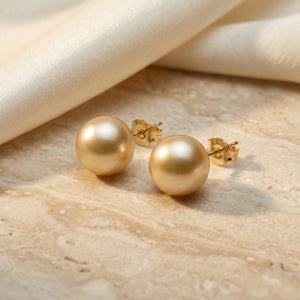
- Tahitian Stud Earrings (9–10mm pair) — Round cable post with screw/butterfly back, 18K solid gold. The darkest stud earring available in fine jewellery. At 9–10mm, these are a genuine presence on the ear without being loud. GRC Top Gem Quality surface quality means the deep colour reads cleanly with no surface noise.
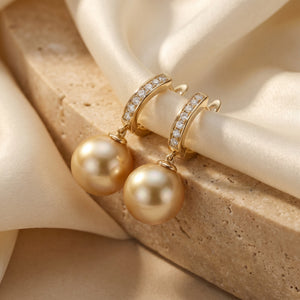
- Tahitian Drop Earrings with Lab Diamonds (9–10mm pair) — Flat cable drop wire with round bezel cup and IGI-certified lab diamond accents, 18K solid gold. The drop format brings the pearl into movement; the lab diamond accents create precisely the dark-on-brilliant contrast described above. These are formal jewellery at the level of a serious occasion — but not costume. The materials justify the setting.
- Tahitian Drop Earrings — Lab Diamond (9–10mm pair) — A lab diamond-only variation on the drop format. Clean, precise, the diamond doing the work alongside the dark pearl.
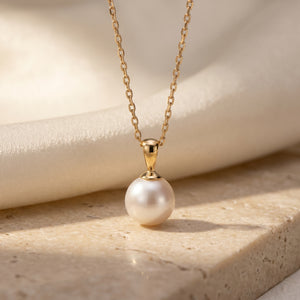
- Tahitian Pendant & Cable Chain (45cm) — A single GRC Top Gem Quality Tahitian pearl on a round cable chain with a round bezel pendant setting, 18K solid gold, with IGI-certified lab diamond accents. A pendant that works as a statement piece without requiring a statement outfit. The dark pearl at the neckline, framed in gold and diamonds, is complete in itself.
Tahitian Pearls and Lab Diamonds — Why the Pairing Works
The choice to set several Tahitian pieces with IGI-certified lab diamonds is not decorative — it is structural. The dark body colour of a Tahitian pearl creates a contrast field that white diamonds read against exceptionally well. A white freshwater or Akoya pearl with diamond accents can feel redundant — two light-coloured, high-luster materials competing for the same visual territory. A dark Tahitian pearl with diamond accents creates a relationship: light and dark, organic and crystalline, the ancient and the modern. The IGI-certified lab diamonds in these settings carry the same D-colour, VVS1-clarity specifications as the stones in Heritage & Co.'s engagement ring collections. The quality consistency across the two categories is intentional.
The Piece That Turns Heads
She will wear the Tahitian pearl pendant to the dinner and someone across the table will ask about it. Not loudly — quietly, leaning in. Because it doesn't look like anything they've seen before, even if they can't immediately identify why. The dark, iridescent surface, the gold setting, the lab diamond catching the restaurant light: it reads as considered, deliberate, and genuinely rare — because it is. A GRC Top Gem Quality Tahitian pearl at 9–10mm in 18K gold is not an entry-level piece. It is the piece a woman reaches for when she wants to be looked at precisely once — and remembered.
Explore Pearl & Fine Jewellery at Heritage & Co.:
Browse Fine Jewellery →
Lab Diamond Jewellery South Africa →
Pearl Types Compared: The Complete Guide →
WhatsApp Us to Enquire About Tahitian Pearl Pieces →