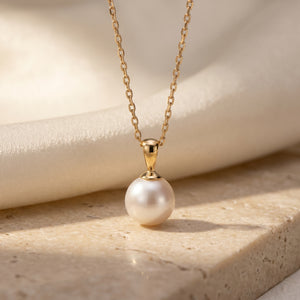
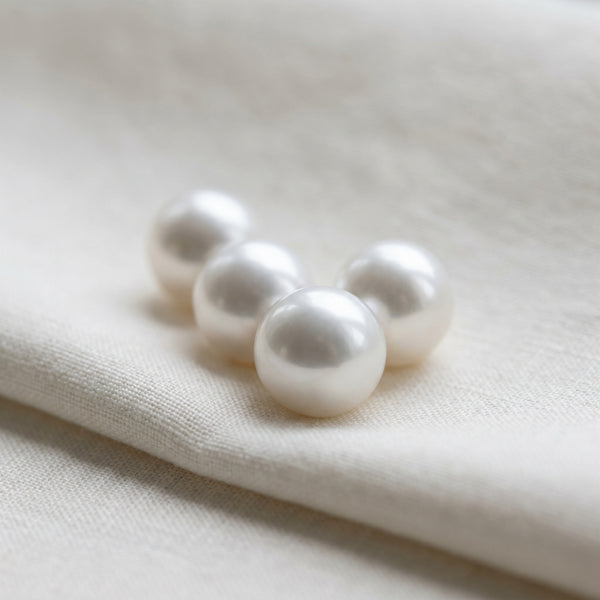
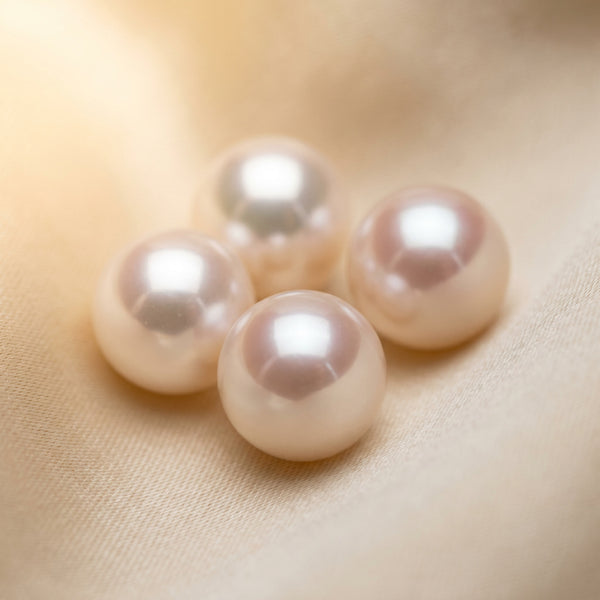
Hold a South Sea pearl in your hand and the first thing you notice is the weight. At 11–12mm, it is simply larger than any other cultured pearl — larger than the Akoya, larger than the Tahitian, larger than any freshwater pearl you have seen in a fine jewellery setting. The second thing you notice is the colour: not white, not dark, but a deep natural gold — warm, luminous, satiny — that exists nowhere else in the pearl world. No other oyster produces it. No treatment creates it. The gold-lipped Pinctada maxima, growing slowly in the warm, pristine waters off northern Australia, produces it over the course of 2–4 years. Only 1–5% of any year's yield reaches GRC Top Gem Quality. What remains is the rarest category in cultured pearl fine jewellery. This is what Heritage & Co. stocks at Tier 4.
The Pinctada Maxima — The Oyster That Changes Everything
The South Sea pearl is produced by Pinctada maxima, the largest pearl-producing oyster species on earth. It lives in the warm, deep waters of the Indo-Pacific — primarily farmed off the northwest coast of Australia (near Broome and the Kimberley coast), the Philippines, and Indonesia. Where the Akoya oyster (Pinctada fucata) is the size of a hand, Pinctada maxima can grow to the size of a dinner plate. Its sheer size means it can accommodate a much larger nucleus — 8mm or more — and layer sufficient nacre around it to produce a pearl of 11–16mm over a 2–4 year growth period.
Pinctada maxima comes in two varieties. The silver-lipped variety produces white and silver-toned South Sea pearls. The gold-lipped variety — with its characteristic golden inner shell — produces the golden South Sea pearl. The golden colour in the pearl comes directly from the oyster's mantle pigmentation transferring into the nacre during growth. It is entirely natural. No dye, no irradiation, no coating. The gold is in the nacre itself, built layer by layer over years.
Why Golden South Sea Pearls Are Rare
The rarity of golden South Sea pearls is not a story. It is arithmetic. Consider the production constraints:
- One pearl per oyster. Unlike freshwater mussels (which host up to 50 pearls simultaneously), Pinctada maxima produces one pearl per harvest cycle. One oyster, one pearl, 2–4 years.
- Oyster mortality. Pinctada maxima is highly sensitive to water temperature, salinity changes, parasites, and environmental stress. A significant percentage of nucleated oysters die before reaching harvest. Every pearl that makes it to harvest represents an oyster that survived years of open-water farming.
- GRC Top Gem Quality yield is 1–5%. Of the pearls that do reach harvest, only the top 1–5% meet GRC Top Gem Quality specification — 95%+ blemish-free surface, very sharp luster, no deep inclusions, excellent matching for paired pieces. The rest grade lower or are discarded.
- Golden colour concentration. Not all gold-lipped oysters produce deeply coloured pearls. Colour saturation varies — light gold, medium gold, and deep gold (the most prized) are all possible outcomes from the same oyster population. Deep golden GRC Top Gem Quality pearls are the rarest output of an already rare process.
This is not analogous to the scarcity of natural diamonds, which is partly geological and partly controlled distribution. South Sea pearl scarcity is simply biological. You cannot accelerate the oyster. You cannot increase its nacre output. You can only farm responsibly and select rigorously at harvest.
South Sea Pearl Grading at GRC Top Gem Quality
| Grade | Surface Quality | Luster | Inclusions | Harvest Yield |
|---|---|---|---|---|
| GRC Top Gem Quality | 95%+ blemish-free. Earrings, pendants, and rings set clean. No spotting visible. | Very sharp. Reflected light sources are sharp and crisp with little to no blurring on edges. Detailed facial recognition. | No deep inclusions allowable. | Top 1–5% of annual yield |
| AAA | 80–85% blemish-free. Slight spotting. 1 deep inclusion allowable, easily hidden. | High to medium. Good facial recognition. Some blurring on edges. | 1 deep inclusion allowable. | Top 5–10% of annual yield |
| AA | 60% blemish-free. Blemishing visible on earrings and pendants. | Low luster. Reflected light sources soft and blurred with slight definition. | 1–2 deep inclusions. | Top 60% of annual yield |
| A (Commercial) | 40% blemish-free. Dull, chalky appearance. | Little to no luster. Very little definition. | Multiple. | Not available for export — nuclei recycled. |
A GRC Top Gem Quality South Sea pearl at 11–12mm has a luster characteristic that differs from Akoya's sharp mirror finish. Where the Akoya is glassy and precise, the South Sea has a deeper, satiny luster — light enters the nacre and glows from within rather than simply reflecting off the surface. At 11–12mm diameter, the pearl's surface acts almost like a softly lit lantern. It is a quality that photographs exceptionally and reads across a room in a way smaller pearls cannot match.
18K Gold — The Only Correct Setting
South Sea pearls are set in 18K solid yellow gold because the setting must be worthy of the pearl. At Tier 4 of the Heritage & Co. pearl collection, the decision to use 18K gold rather than 14K or 10K is not tier-marking — it is material logic. The deeper, richer yellow of 18K gold (75% pure gold vs 58% in 14K) is the correct visual complement to the warm, deep golden colour of a South Sea pearl. The two golds — the pearl's natural gold and the setting's 18K gold — are in the same family of warmth. The setting amplifies the pearl rather than contrasting with it.
950 platinum options are also available for those who prefer the contrast of a cool, silver-toned setting against the warm golden pearl. It is a striking alternative — the temperature contrast is deliberate and sophisticated.
The Heritage & Co. South Sea Collection
The South Sea range is the flagship tier of the Heritage & Co. pearl collection. It is the most expansive in terms of piece variety — including, uniquely, a solitaire ring — and the most elevated in setting specification. All pieces are in 18K solid yellow gold or 950 platinum, with multiple pieces featuring IGI-certified lab diamonds.
- South Sea Stud Earrings (11–12mm pair) — Heavy round cable post with screw back, 18K solid gold. At 11–12mm, these are the most substantial stud earring available in any material in fine jewellery. The screw-back fitting is the correct mechanism for a pearl of this weight. On the ear, they are unmissable and entirely composed.
- South Sea Stud Earrings with Lab Diamond (11–12mm pair) — As above, with IGI-certified lab diamond accents. The diamond adds a secondary light source at the lobe — a frame of white brilliance around the golden pearl. These are the pair for the woman who wants maximum presence with complete control.
- South Sea Drop Earrings with Diamond Pavé — Heavy cable drop with bezel cup and pavé diamond collar, 18K solid gold. The pavé diamond collar wraps the base of each pearl in a ring of continuous brilliance. This is formal fine jewellery at the level of any international luxury house. The movement of a drop earring at this specification — the pearl moving with the wearer, the diamonds catching the light — is the kind of detail that reads on camera and in life.
- South Sea Drop Earrings with Rope Design — Heavy cable drop with rope-detail bezel, 18K solid gold. A more architectural interpretation of the drop format — the rope motif is a classic maritime reference appropriate to a pearl of oceanic origin. No diamonds; the setting does the work through texture.
- South Sea Pendant — Double Halo Lab Diamond (Belcher chain, 45cm) — A GRC Top Gem Quality golden South Sea pearl set in a double halo of IGI-certified lab diamonds on a heavy belcher/rolo chain, 18K solid gold. The double halo is two concentric rings of diamonds around the pearl — an architecture that creates depth and frames the pearl's golden surface within multiple planes of light. The belcher chain (equal circular links) matches the weight and presence of the pendant. This is a piece that changes what a neckline looks like.
- South Sea Pendant — Single Bezel (Belcher chain, 45cm) — A GRC Top Gem Quality golden South Sea pearl in a heavy round bezel pendant setting on a belcher chain, 18K solid gold. The single bezel version — cleaner, more minimal than the double halo — lets the pearl lead entirely. The belcher chain at this gold content has weight that the Singapore and cable chains of the lower tiers cannot replicate. This is the pendant for a buyer who wants presence without decoration.
- South Sea Solitaire Ring (9–10mm) — A GRC Top Gem Quality golden South Sea pearl in a solitaire ring setting, 18K solid gold. The ring is the rarest piece in the collection and the most significant design choice: a pearl ring at this size and grade is a contemporary alternative to the diamond solitaire — for an anniversary, a milestone, or a woman who does not want what everyone else has. The solitaire ring setting is clean and precise, designed to present the pearl at its maximum diameter with no visual competition from the mount.
Golden South Sea Pearls with IGI Lab Diamonds — The Logic
The decision to pair South Sea pearls with IGI-certified lab diamonds (D/VVS1) is the same logic applied to the Tahitian range — but the effect is different. Where dark Tahitian pearls and white diamonds create contrast, golden South Sea pearls and white diamonds create harmony. Both the pearl's golden nacre and the diamond's colourless brilliance are warm in light — the pearl from the gold tones in its nacre, the diamond from the fire it disperses. In the same piece, they create a layered luminosity: the pearl's satiny warmth underscored by the diamond's crisp brilliance. The double halo pendant demonstrates this effect at its most developed.
The Piece That Lasts Everything
The golden South Sea pearl is the jewellery equivalent of a long-term investment — not in financial terms, though that holds, but in terms of what it means on the day it is given and what it means twenty years later. It does not date. It does not follow a trend. A 11mm GRC Top Gem Quality golden South Sea pearl in 18K gold set with lab diamonds looks correct in a 1960 photograph, correct in 2026, and will look correct in 2046. The woman who receives it knows this — not because she is told, but because she can feel the weight and see the quality and understand that this is not a gesture. This is a decision.
Explore the South Sea Pearl Collection & Fine Jewellery:
Browse Fine Jewellery →
Lab Diamond Jewellery South Africa →
Pearl Types Compared: The Complete Guide →
Tahitian Pearls: The World's Only Naturally Dark Pearl →
WhatsApp Us to Enquire About South Sea Pearl Pieces →