Every gemstone on earth — diamonds, rubies, sapphires, emeralds — formed here, inside our planet, under conditions only earth provides. Every one of them, with one extraordinary exception. There is a gem on this planet that wasn't made here. It arrived from space. And you might already own one.
Meet Peridot: Earth's Alien Gemstone
Peridot (pronounced PEHR-ih-doh) is the gem variety of olivine, a magnesium iron silicate mineral. Its chemical formula is (Mg,Fe)₂SiO₄. Its colour — that distinctive lime green with a slight gold undertone — is caused by iron content within the crystal structure. No other gem produces quite that colour, which ancient Egyptians called "the gem of the sun."
Olivine is not rare on earth. It's actually the most abundant mineral in the earth's upper mantle — the zone between the crust and the core, extending from roughly 30km to 650km depth. Almost everything directly beneath your feet is olivine. When basaltic volcanism occurs, fragments of the mantle (called xenoliths) get carried to the surface, often containing gem-quality peridot crystals. The San Carlos Apache Reservation in Arizona sits on one of the world's richest deposits — the ground there is so dense with olivine crystals that the soil itself glitters green in sunlight. Peridot Mesa, they call it.
So far, perfectly earthly. Then things get interesting.
Pallasites: The Most Beautiful Meteorites on Earth
In 1772, a German naturalist named Peter Simon Pallas was shown a strange 700-kilogram mass of iron and rock near Krasnoярsk, Siberia, that local people had known about for generations. When scientists cut it open, they found something unlike any earthly rock: a matrix of silver iron-nickel metal, threaded throughout with transparent yellow-green crystals — olivine, the same mineral as peridot. The meteorite was named after Pallas. The class of meteorites it belongs to — stony-iron meteorites with this structure — are now called pallasites.
There are fewer than 120 known pallasites on earth. They are extraordinarily rare. And they are, arguably, the most beautiful rocks on the planet.
Where Pallasites Come From
To understand pallasites, you need to understand what happened in the first few hundred million years of the solar system. When rocky bodies grow large enough (roughly 200km in diameter), they undergo a process called differentiation: gravity pulls heavier elements like iron and nickel toward the core, while lighter silicate minerals float to the surface. The body develops a core, a mantle, and a crust — just like Earth.
In the early solar system, many such bodies formed and differentiated. Then, in a chaotic period of collisions, many of them were destroyed — smashed by other bodies and reduced to fragments. These fragments are what we now call meteorites.
Pallasites are thought to be pieces from the core-mantle boundary of these destroyed protoplanets — the exact zone where iron-nickel metal met silicate mantle rock, and where olivine/peridot crystals had accumulated. When the parent asteroid was destroyed, these boundary zone pieces were launched into space. For billions of years — sometimes longer than the age of the Earth — they drifted through the solar system. Eventually, some of them fell here.
The peridot crystals inside a pallasite didn't form in any volcano. They didn't come from any mantle xenolith. They formed inside a different planetary body, in a different part of the solar system, billions of years ago. They are older than Earth.
The Fukang Meteorite
In 2000, a hiker near Fukang in China's Xinjiang province stumbled across an enormous metal-and-stone mass half-buried in the landscape. Initial tests confirmed it was a meteorite. When scientists cut cross-sections and backlit them, the photographs became some of the most shared images in the history of geology: centimetre-scale peridot crystals glowing amber and gold, suspended in a silver iron-nickel matrix like windows in a cathedral wall. The Fukang meteorite weighs over 1,000 kilograms. At auction in 2008, a portion of it sold for over $2 million.
The Esquel pallasite, found in Argentina in 1951, is equally remarkable — its crystals are particularly large and clear, and slices of it are kept in major natural history museums. Cut and polished, individual Esquel slices sell for thousands of dollars.
The Only Common Gem Found in Meteorites
Diamonds have been found in meteorites — but only as microscopic nano-diamonds in carbonaceous chondrites, too small to see and utterly unusable as gemstones. No other commonly known gem occurs in meteorites in gem-quality crystals. Peridot is unique. It is the only gemstone a buyer can hold in their hand that may have spent billions of years drifting through interplanetary space.
Peridot sold as meteoritic material is rare and expensive — small faceted stones from pallasites command premium prices among collectors. The far more common commercial peridot comes from terrestrial sources (Arizona, Pakistan, Myanmar, China, Egypt's Zabargad Island). But the geological story behind the stone — and the fact that its crystalline cousins have been tumbling through the solar system since before our planet existed — makes it one of the most remarkable gemstones in any collection.
Ancient Egyptians Called It the Gem of the Sun
Peridot has been mined since at least 1500 BCE. The ancient Egyptians sourced it from Zabargad Island in the Red Sea (which they called the "Isle of Serpents" — to discourage competitors). Cleopatra's famous emerald collection may have partially been peridot — descriptions of her gems match the stone's golden-green hue more closely than true emerald. The Romans called it "Evening Emerald" because, unlike emerald, its colour doesn't darken under artificial light. Medieval European cathedrals used large peridot stones set in gold reliquaries — several examples survive in Cologne Cathedral to this day.
Peridot in Fine Jewellery
Peridot is a 6.5–7 on the Mohs hardness scale — softer than sapphire or diamond, making it better suited to earrings and pendants than everyday rings. Its colour is unique: no other gem produces that specific golden-lime green. It requires no treatment — no heat, no irradiation, no filling. The colour you see is exactly what the crystal is.
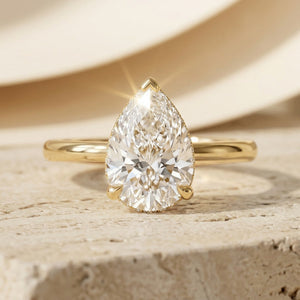
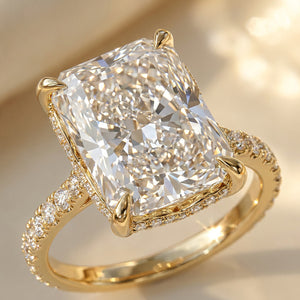
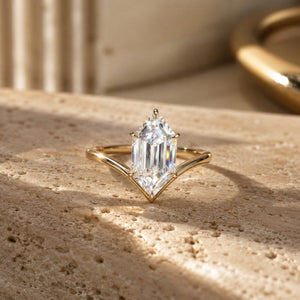
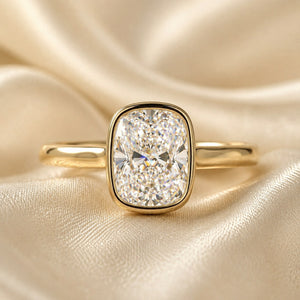
At Heritage & Co., we specialise in moissanite and lab diamond for engagement rings and fine jewellery — stones we can certify, grade, and guarantee. But knowing the full story of gemstones — including the ones that arrived from another world — is part of what makes fine jewellery mean something. Every stone has a history. Peridot's history just happens to predate the solar system.
The Universe in a Ring Box
Somewhere in a museum in Arizona, there's a peridot crystal that formed inside a protoplanet before Earth existed. It survived the destruction of that planet, a multi-billion-year journey through interplanetary space, entry through our atmosphere, and burial on a Chinese hillside — before being found by a hiker who happened to look down. That's not a metaphor. That's the actual geological record.
Fine jewellery, at its best, carries that kind of weight. If you want to find your stone — one with its own remarkable story — chat with us on WhatsApp. We'd love to help you choose.
Explore Heritage & Co.
- Fine Jewellery Collection — moissanite & lab diamond, solid gold
- Engagement Rings — INVICTA, AETERNA & CLARITAS
- Lab Diamond vs Moissanite — Full Comparison