Every year, millions of rands are spent on the assumption that mined diamonds are fundamentally superior to lab-grown ones. But once you understand how both are made — at the atomic level — that assumption falls apart quickly. Here's what the science actually says, and why it matters before you spend a cent on a ring.
How Mined Diamonds Form
Deep in the earth's mantle, 150–200 kilometres below the surface, temperatures exceed 1,000°C and pressures reach 50,000 times atmospheric pressure at sea level. Under these conditions, pure carbon atoms compress into a cubic crystal lattice — the hardest natural structure on earth. This process takes between one billion and three billion years.
When ancient volcanic eruptions force kimberlite magma surging upward through the earth's crust, it drags these diamond crystals with it, encasing them in volcanic rock called kimberlite pipes. These are the deposits miners excavate today. Every mined diamond ring ever made began with a billion-year wait and a volcanic event.
How Lab Diamonds Are Made
Two methods exist, and both replicate the same physical conditions that form diamonds in nature.
HPHT (High Pressure High Temperature) places a carbon seed crystal inside a chamber and subjects it to 60,000 atmospheres of pressure at temperatures above 1,400°C — recreating mantle conditions. Carbon dissolves into a metallic flux solution and crystallises around the seed, growing a rough diamond over days to weeks.
CVD (Chemical Vapour Deposition) pumps carbon-rich gas (typically methane) into a chamber where microwave energy strips carbon atoms free, allowing them to settle layer by layer onto a diamond seed — like microscopic snow accumulating. The result is a crystal that grows plate by plate and can be cut to any shape.
Both methods produce diamonds. Not diamond alternatives. Not simulants. Diamonds — with the exact same carbon atom arrangement, the exact same hardness (10 on the Mohs scale), the exact same refractive index, and the exact same chemical formula: C.
They Are Molecularly Identical
Take a IGI-certified lab diamond and a IGI-certified mined diamond of equivalent grade. A gemologist examining both under a 10× loupe cannot determine which is which. Put them under a spectrometer — the light absorption signatures are identical. The Gemological Institute of America grades both on exactly the same scale using exactly the same criteria, because they are the same material.
The only atomic-level differences are trace impurities: natural diamonds commonly contain trace nitrogen absorbed from the mantle environment; CVD-grown diamonds can contain trace boron. These differences exist on a spectrum and are not visible — even under magnification.
Both Methods Produce Inclusions
This is where it gets important for buyers. Both the earth's mantle and the laboratory introduce imperfections during crystal growth. These internal characteristics — called inclusions — are exactly what the GIA clarity scale measures. And critically: the same types of inclusions occur in both mined and lab-grown diamonds.
The Inclusion Types Every Buyer Should Know
Black spots (carbon inclusions): Microscopic clusters of uncrystallised carbon trapped inside the growing crystal. In mined diamonds, these form when the growing crystal encases graphite particles. In HPHT lab diamonds, residual metallic flux can create similar dark inclusions. Visible in lower-grade stones as tiny dark pinpoints under magnification.
Feathers: Internal fractures that — under magnification — fan out like a feather's edge. In mined diamonds, these form from the shock of the kimberlite eruption or subsequent geological stress. In lab diamonds, rapid crystal growth can produce similar micro-fractures. Feathers that reach the stone's surface are particularly significant: impact can propagate the fracture.
Clouds: Diffuse, hazy clusters of tiny pinpoint inclusions — too small to distinguish individually — that create a milky or foggy zone in the stone. Heavy clouds don't just affect the clarity grade; they reduce the stone's ability to transmit and return light. Both origins produce clouds; both are graded identically.
Needles: Elongated, narrow crystal inclusions inside the stone, usually white or transparent, resembling a scratch from within. Common in both origins.
Pinpoints: Tiny individual crystal inclusions barely visible at 10× magnification. A single pinpoint barely affects the grade; a cluster forms a cloud.
Cavities: Small surface openings, typically created during polishing when a crystal inclusion is dislodged. Found in stones of both origins.
Graining: Internal irregularities in the crystal lattice — growth lines from uneven formation. More common in natural diamonds due to the uncontrolled growth environment of the earth's mantle.
Quality Grade = Price — In Both Markets
A VVS1 (Very Very Slightly Included) diamond carries inclusions so subtle that a trained gemologist under 10× magnification struggles to locate them. An SI2 (Slightly Included) diamond carries inclusions visible to a trained eye under magnification — and potentially visible to the naked eye in certain lighting conditions. This quality gradient is real, and it applies identically to both mined and lab diamonds.
A D/VVS1 lab diamond competes with a D/VVS1 mined diamond on the same quality criteria. The IGI uses the same grading language and the same grades for both. What changes is the price. A 1-carat D/VVS1 mined diamond can cost R100,000–R250,000 in South Africa. A 1-carat D/VVS1 lab diamond of equivalent grade: R15,000–R45,000. The stone is identical. The price reflects marketing history — not material differences.
The Detection Problem: Even the Machines Struggle
The only reliable way to distinguish a lab diamond from a mined one is a specialised instrument: a diamond type analyser such as the De Beers DiamondView or IGI iD100. These devices use ultraviolet fluorescence and photoluminescence spectroscopy to detect subtle differences in nitrogen or boron patterns at the crystal lattice level.
These machines cost tens of thousands of dollars. Most jewellers don't own one. And the science on accuracy is imperfect: high-quality CVD diamonds can produce ambiguous results even on professional instruments, particularly when post-growth treatment has occurred.
A standard diamond tester (thermal or electrical conductivity) — the kind every jeweller keeps on their counter — identifies moissanite vs diamond. It cannot distinguish lab from mined. A gemologist with a loupe cannot tell. GIA-trained graduates examining ungraded stones frequently cannot tell. The human eye has no shot. Only a specialist laboratory under controlled conditions can make the call, and even then, it's not always clean.
At Heritage & Co.
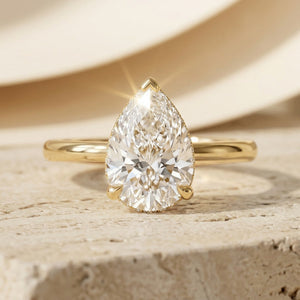
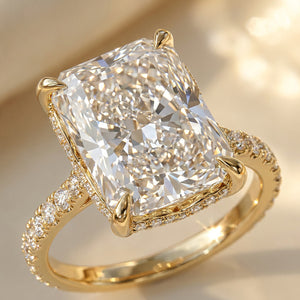
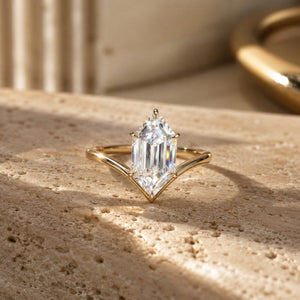
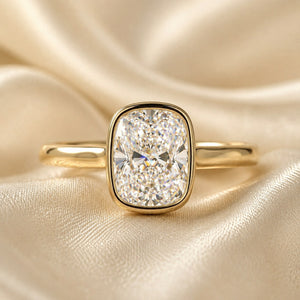
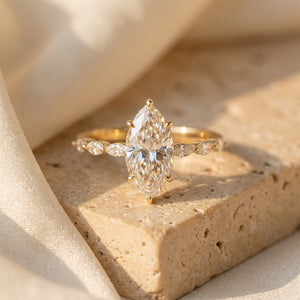
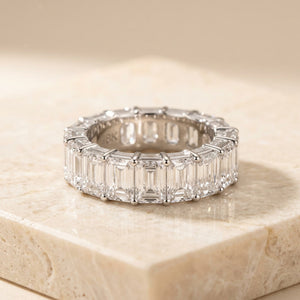
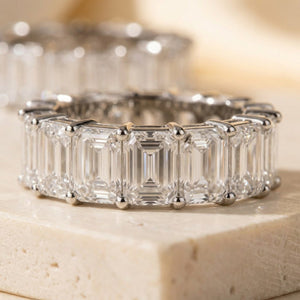
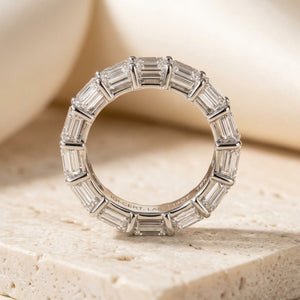
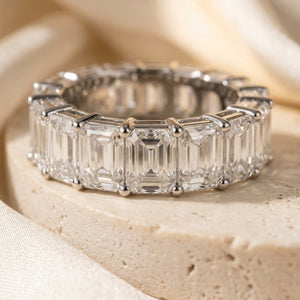
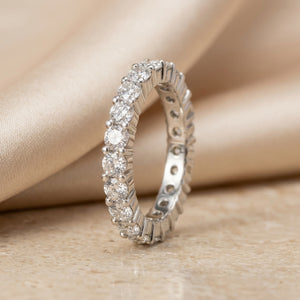
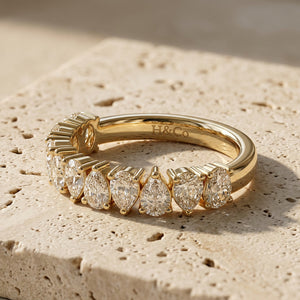
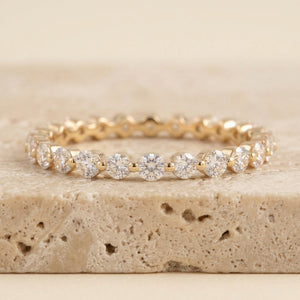
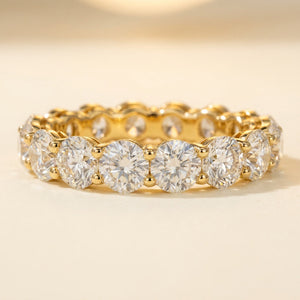
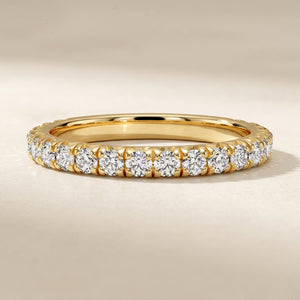
The CLARITAS collection offers IGI-certified lab diamonds graded D/VVS1 — the top of the clarity and colour scale — set in 18K solid gold, from R30,000. You are buying a diamond. The same atomic structure, the same hardness, the same certificate, the same fire. The origin is a laboratory rather than the earth's mantle — and that difference saves you, in some cases, R200,000 on a stone you cannot visually distinguish.
The AETERNA collection offers GRA-certified moissanite (D/VVS1) in 14K solid gold from R16,000. Moissanite is a different material — silicon carbide rather than carbon — but its refractive index actually exceeds diamond's, producing more fire (the rainbow light dispersion). For those who want maximum visual impact without the diamond premium, nothing competes.
The Ring She Won't Stop Looking At
When light catches it and she finds herself staring at the stone for the hundredth time — she isn't thinking about kimberlite pipes or chemical vapour deposition. She's seeing fire. Brilliance. Life inside the stone. That optical performance is a function of cut quality, clarity grade, and the physics of light refraction. Not geology. A D/VVS1 lab diamond and a D/VVS1 mined diamond produce that moment equally well.
The difference is that with a lab diamond, there's budget left for the 18K gold setting, the honeymoon, or the ring she'll actually want to wear every day for the next sixty years. Chat to us on WhatsApp — we'll show you exactly what your budget can buy.
Explore Heritage & Co.
- CLARITAS Lab Diamond Rings — IGI D/VVS1, 18K solid gold, from R30,000
- AETERNA Moissanite Rings — GRA D/VVS1, 14K solid gold, from R16,000
- Lab Diamond vs Moissanite — Full Comparison
- Lab Diamonds in South Africa — Complete Guide