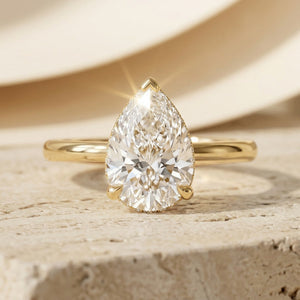
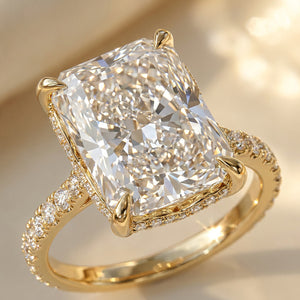
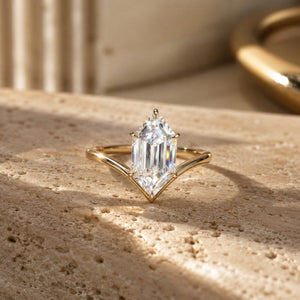
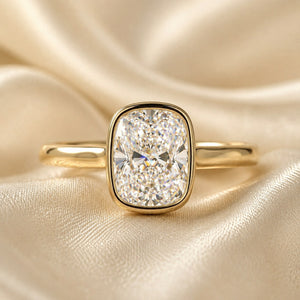
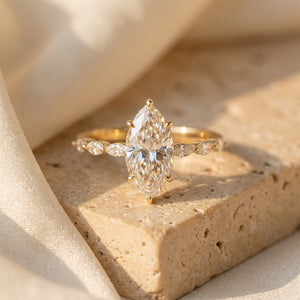
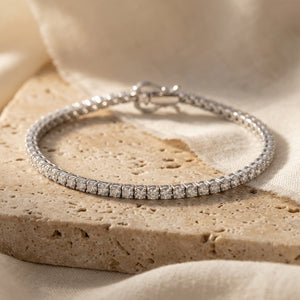
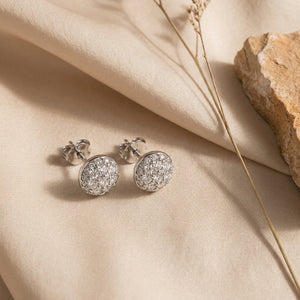
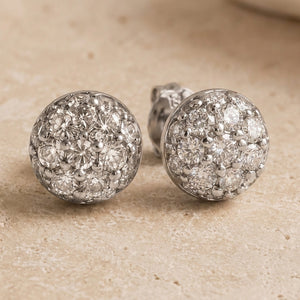
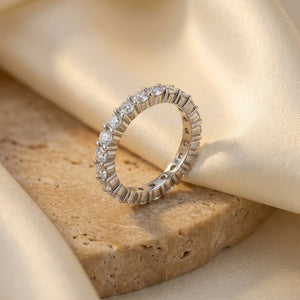
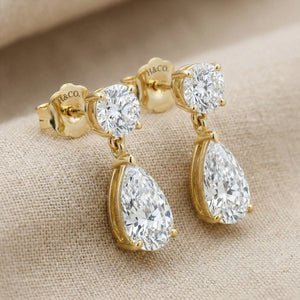
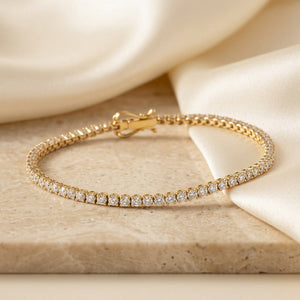
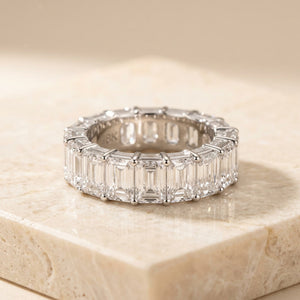
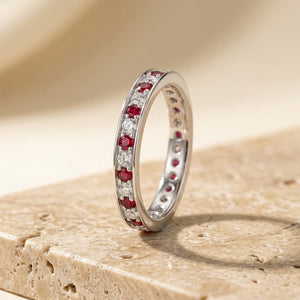
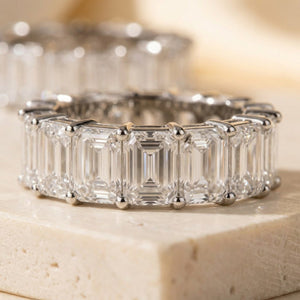
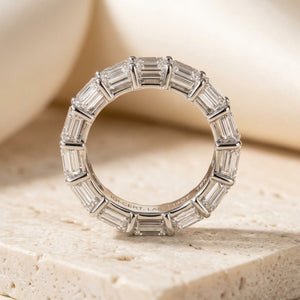
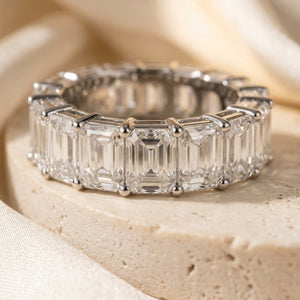
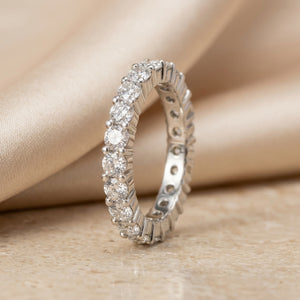
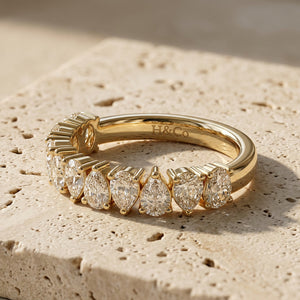
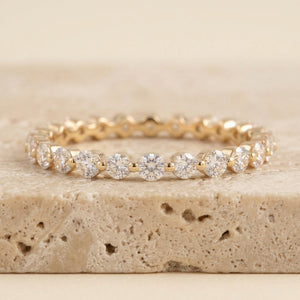
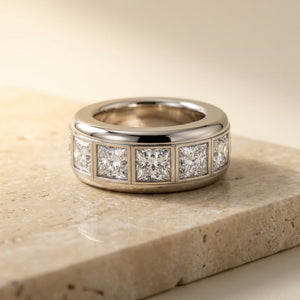
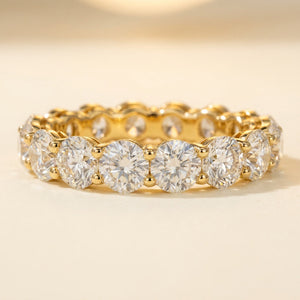
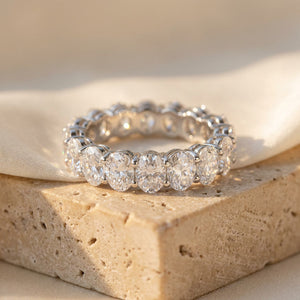
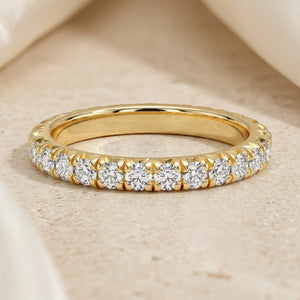
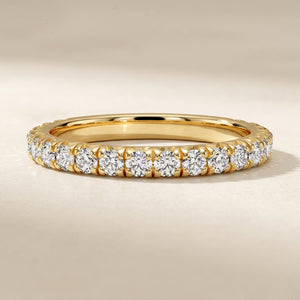
There is a specific moment — you've probably seen it, even if you didn't know what you were seeing — when someone holds a ring up to the light and the stone seems to come alive. It doesn't just reflect light. It amplifies it. It gathers light from every direction, bounces it internally, and fires it back out in every wavelength simultaneously. For a second, it looks like the stone is lit from within — like it contains its own light source. That is not an illusion. That is physics. And understanding it makes you never look at a stone the same way again.
What "Ideal Cut" Actually Means
The term "ideal cut" refers to the proportions first mathematically derived by Marcel Tolkowsky in 1919 — a specific set of angles, ratios, and facet arrangements calculated to produce the maximum possible light return in a round brilliant diamond. An ideal-cut stone wastes almost no incoming light. What goes in comes back out, spectacularly.
For a round brilliant, the ideal specifications (per the GIA Excellent grade, the closest commercial standard to Tolkowsky's original) include: a crown angle between 31.5° and 36.5°, a pavilion angle between 40.6° and 41.8°, a table percentage between 52% and 62% of the girdle diameter, and a total depth between 59% and 62.5%. These numbers are not arbitrary — they are derived from the optical physics of diamond's specific refractive index (2.42).
Total Internal Reflection: Why the Stone Doesn't "Leak"
Every transparent material has a property called the critical angle — the angle beyond which light inside the material cannot escape through the surface. Instead, it bounces back internally, perfectly, like a mirror. For diamond, this critical angle is about 24.5°. For comparison, glass is around 42°, water is 49°.
When light enters a diamond's table and travels down to the pavilion facets, it hits them at steep angles — deliberately engineered to exceed the critical angle. This means the pavilion facet acts as a perfect mirror: 100% of the light bounces back upward. None of it leaks through the base of the stone. It then hits the opposite pavilion facet, bounces again, and exits through the crown facets at the top — directly toward the viewer.
If the pavilion angles are too shallow — a "flat" cut — the light hits the pavilion below the critical angle and passes straight through the bottom. The stone looks like a window: transparent, colourless, dead. If the pavilion angles are too deep — a "deep" cut — light exits through the side of the stone rather than the top. Both produce stones that look grey or glassy under normal lighting. Only the specific ideal range traps the light correctly.
Brilliance, Fire, and Scintillation: Three Separate Phenomena
The sparkle of a well-cut stone is actually three distinct optical effects occurring simultaneously:
Brilliance is the return of white light to the viewer's eye. When you look straight down into an ideal-cut stone and it appears bright, almost glowing — that's brilliance. It is the measure of how efficiently the stone returns light upward. A stone with poor brilliance looks dark, glassy, or "asleep."
Fire is the dispersion of light into its spectral colours — the flashes of red, orange, blue, and violet that shoot from the crown facets when the stone moves. White light is made up of all wavelengths. When it refracts through the crown facets, different wavelengths bend by slightly different amounts, separating into their component colours. This is identically what happens in a prism or a rainbow. The property that governs fire is dispersion: diamond's dispersion coefficient is 0.044; moissanite's is 0.104 — more than double. This is the reason a moissanite of identical cut quality to a diamond will produce visibly more fire — more and larger rainbow flashes. Some buyers love it; some prefer the slightly whiter appearance of diamond. Both are correct preferences.
Scintillation is the dynamic sparkle — the flashing pattern of light and shadow that appears as the stone or the light source moves. A well-cut stone in motion produces a pinwheel of bright flashes across its facets. This is why a ring looks so different under a chandelier versus outdoors in flat light: scintillation requires angular variation in the light source. Diffuse outdoor light reduces scintillation; a restaurant with multiple light sources maximises it.
Why Some Diamonds Look Like They're Glowing
The phenomenon you sometimes see — a stone that appears to emit light rather than just reflect it — is the result of all three effects occurring at peak efficiency simultaneously. Under the right lighting, an ideal-cut stone with high clarity gathers light from every angle (the facets work as a curved array of tiny mirrors), conducts it internally without loss (total internal reflection), and fires it back out through the crown in white flashes (brilliance) punctuated by spectral colour (fire) that seem to come from inside rather than outside the stone. The eye interprets this — correctly — as a source of light, not just a reflector of it.
It looks magical because the optics genuinely are extraordinary. The refractive index of diamond (2.42) is among the highest of any transparent material on earth. Diamond's critical angle (24.5°) is much smaller than that of most gems, which means its pavilion can bounce light back more efficiently at a wider range of incident angles. A well-cut diamond or moissanite in a well-lit room genuinely gathers more light than enters it through the table — drawing in light from peripheral angles and funnelling it toward the viewer.
Why Moissanite Can Look More Spectacular Than Diamond
Moissanite's refractive index (2.65–2.69) is slightly higher than diamond's (2.42). Its dispersion (0.104) is significantly higher than diamond's (0.044). In practice, this means an ideal-cut moissanite produces more fire than an equivalent diamond — larger, more frequent rainbow flashes. For observers who notice and value fire, moissanite is genuinely more spectacular. For those who prefer a cleaner white brilliance (the effect associated with diamond's slightly lower fire), diamond delivers that.
This is not a matter of one being better. It is a matter of which optical profile resonates with the person wearing the ring. Some people see a moissanite in sunlight and can't stop looking at it. Others prefer the more restrained brilliance of diamond. Both are valid responses to two genuinely different but equally excellent optical performances.
The Ring That Finds You
There is a particular moment when someone sees the stone that is right for them under the right light. Something happens in the brain — not just aesthetic appreciation, but something more immediate, more physical. The stone seems to demand attention. The fire catches. The brilliance flares. Every movement of the hand brings another flash from a different facet. You find yourself turning the ring slowly, watching the patterns change.
That experience is not luck. It is the result of a cut that was designed, mathematically, over a century ago, to produce exactly that reaction. The geometry was optimised. The angles were calculated. The facets were placed to execute a specific optical outcome — and in an ideal-cut stone, they achieve it every time.
Our AETERNA moissanite collection starts from R16,000 in 14K gold. Our CLARITAS lab diamond collection starts from R30,000 in 18K gold. Both feature stones cut to ideal specifications — chosen because anything less leaves light on the table, and the light is the whole point. To see them, chat with us on WhatsApp.
Explore Heritage & Co.
- AETERNA Moissanite — ideal cut, GRA D/VVS1, 14K gold, from R16,000
- CLARITAS Lab Diamond — ideal cut, IGI D/VVS1, 18K gold, from R30,000
- Lab Diamond vs Moissanite — Which Optical Profile is Right for You?
- All Engagement Rings