For most of human history, diamonds were worn exactly as they came out of the ground — rough, uncut octahedral crystals, prized for their hardness and mysterious clarity but not for brilliance or fire. The visual drama we associate with diamonds today — the fire, the rainbow flashes, the white light shooting from every angle — does not come from the stone. It comes entirely from the cut. And the story of how humanity learned to cut a diamond is one of the most overlooked chapters in design history.
Before Faceting: The Natural Crystal
Diamond's natural growth form is the octahedron — a double-pyramid shape, like two pyramids joined at their base. Ancient Indian, Roman, and Greek jewellers set these rough crystals directly into gold, valuing their hardness (diamond will scratch anything, including other diamonds) and their glassy transparency. A rough diamond in candlelight has some lustre, some surface reflection, but almost none of the internal light display that defines modern diamond jewellery. The light enters the stone, bounces around, and mostly escapes out the bottom rather than returning upward to the eye.
Nobody knew, for most of antiquity, that the right geometry could change that completely.
The Point Cut: 14th Century
The first "cut" was barely a cut at all. European jewellers in the 14th century began polishing the eight natural faces of the octahedron to improve their smoothness and reflectivity, without fundamentally altering the stone's shape. The result — the point cut — was simply a polished version of nature's original form. It improved lustre but did nothing for the internal light return that would later define the brilliant cut.
The Table Cut: 15th Century
The first true departure from natural form came in the 15th century. Jewellers discovered that cutting the top point of the octahedron flat — creating a flat facet called the table — opened the stone to incoming light in a new way. The light now entered through a larger, more accessible surface and created more internal reflections. Additional facets were added to the crown and pavilion. The table cut, with its characteristic flat top and stepped sides, became the dominant diamond cut for over two centuries. Many surviving Tudor and Renaissance jewels feature table-cut diamonds still in their original settings.
The Old Mine Cut: 17th–18th Century
As cutters gained skill and theoretical understanding of how light moves through crystal, the Old Mine Cut emerged in the 17th century as the first recognisably modern diamond cut. It was cushion-shaped (following the natural octahedral crystal outline rather than forcing a round shape) with a high crown, a small table, a large culet (flat bottom facet), and approximately 58 facets arranged to produce some sparkle and fire. By candlelight — the only artificial light available — the Old Mine Cut performed beautifully. Its warm glow under flame made it the defining cut of the Georgian and early Victorian eras.
Old Mine Cut diamonds are still traded today as antique stones. Their look is distinctive — that high crown, the chunky cushion outline, the visible culet when viewed through the table — and some buyers specifically seek them for their historical character.
The Old European Cut: Late 19th Century
As industrial cutting technology improved through the 1800s, the Old European Cut refined the Old Mine's geometry into a circular outline. It maintained the high crown and deep pavilion of its predecessor but introduced the round shape that would become standard. By this point, spectroscopic understanding of light refraction was advancing, and cutters were beginning to understand — intuitively if not mathematically — that specific angles produced more light return than others. Old European Cut diamonds, particularly from the 1890s–1920s, are prized by collectors for their exceptional craftsmanship and their romantic aesthetic.
Marcel Tolkowsky and the Brilliant Cut: 1919
In 1919, a 21-year-old Belgian engineer and diamond cutter named Marcel Tolkowsky published his doctoral thesis: Diamond Design: A Study of the Reflection and Refraction of Light in a Diamond. Using Snell's Law and optical trigonometry, he calculated the precise angles at which a round diamond's pavilion and crown facets would maximise two competing goals: brilliance (white light returned upward to the eye) and fire (the dispersion of that light into spectral colours).
His result specified a crown angle of 34.5°, a pavilion angle of 40.75°, a table diameter of 53% of the girdle diameter, and 57 facets (or 58 including the culet). This was the Round Brilliant Cut — the same fundamental geometry used in the vast majority of diamonds and moissanite stones sold today, a century later.
Tolkowsky's insight was that previous cuts had optimised for either brilliance OR fire, but not both simultaneously. His specific angles achieved total internal reflection on the pavilion facets (light bouncing back up rather than leaking through the bottom) while also dispersing that returned light through the crown facets into its spectral components. The mathematical derivation held. And it has been the industry standard ever since.
What Facets Do to Light
Every facet on a diamond or moissanite performs a specific optical function:
Reflection: When light hits a flat, polished facet surface from outside, some of it bounces back — external reflections that create the surface lustre you see on a well-polished stone. This is why cutting quality matters: a well-polished facet reflects cleanly; a poorly polished one scatters light diffusely.
Refraction: Light that enters the stone bends as it crosses the air-to-crystal boundary (because light travels more slowly through dense crystal than through air). The degree of bending is the refractive index — diamond at 2.42, moissanite at 2.65–2.69. Higher refractive index means more bending at each interface, which means more fire.
Total Internal Reflection: When light inside the crystal hits a pavilion facet at an angle greater than the "critical angle" (determined by the refractive index), it doesn't pass through — it bounces back entirely, as perfectly as a mirror. Tolkowsky's pavilion angles were chosen to keep all incoming light above this critical angle, ensuring maximum light return up through the crown.
Dispersion (fire): White light is actually a mixture of all wavelengths (colours). When it refracts through the crown facets, different wavelengths bend by slightly different amounts — splitting the white light into spectral colours. This is what creates the rainbow flashes — the "fire" — that shoot from the crown facets as the stone moves. Diamond's dispersion rate is 0.044; moissanite's is 0.104 — more than twice as high, which is why moissanite produces more fire than diamond of equivalent cut quality.
The Cuts Available Today
The brilliant cut principle has been applied to dozens of stone shapes since 1919:
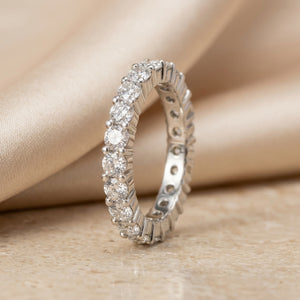
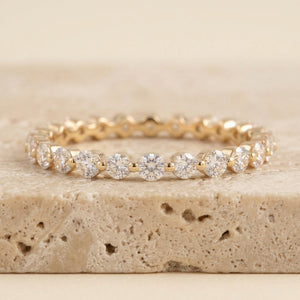
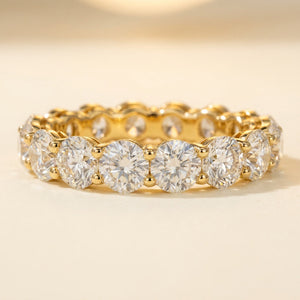
Round Brilliant: The mathematical original — 57 facets, circular outline, the benchmark against which all other cuts are compared.
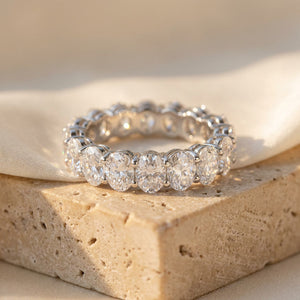
Oval: An elongated brilliant — similar facet structure to round, but the elongated shape creates a visual illusion of a larger stone for the same carat weight. Hugely popular in South Africa right now. Available in AETERNA and CLARITAS.
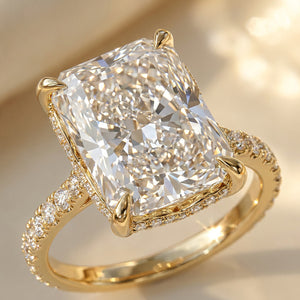
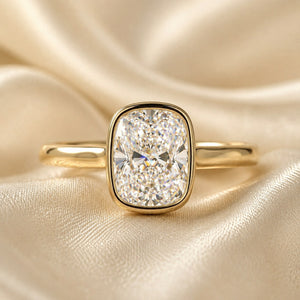
Cushion: A square or rectangular outline with rounded corners, inspired by the Old Mine Cut. Available in brilliant or "modified brilliant" (crushed ice) facet patterns. AETERNA AURORA features an elongated cushion — its crushed ice faceting creates a distinctive scattered sparkle.
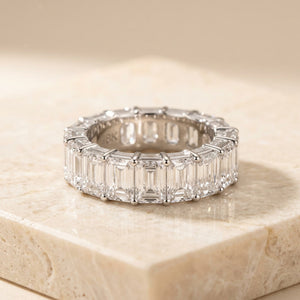
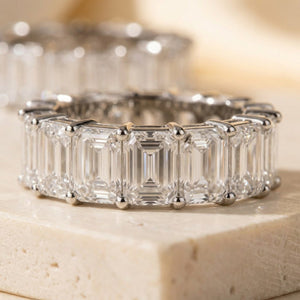
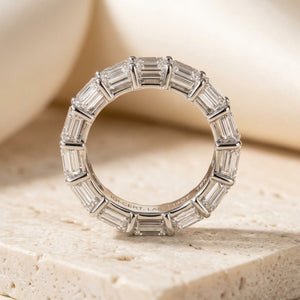
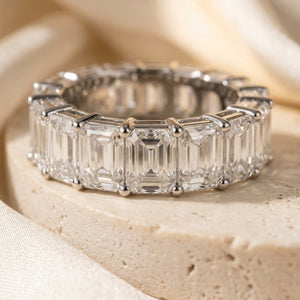
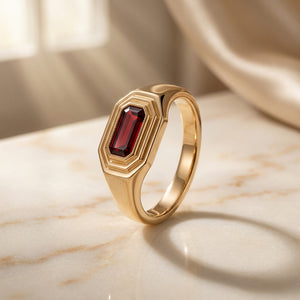
Emerald: A step cut rather than a brilliant cut — long, parallel facets like steps in a staircase. This creates "hall of mirrors" flashes rather than fire, and emphasises clarity over brilliance. Any inclusion is highly visible in an emerald cut — which is why D/VVS1 grades matter more here than in any other shape.
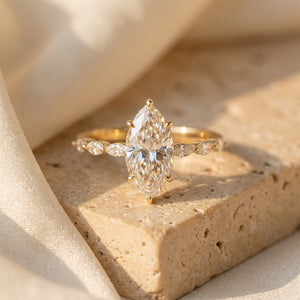
Marquise: An elongated oval that comes to points at both ends — named after the Marquise de Pompadour, for whom Louis XV allegedly commissioned a stone cut to resemble the shape of her lips. Extremely flattering on the finger, creating the longest visual silhouette of any cut.
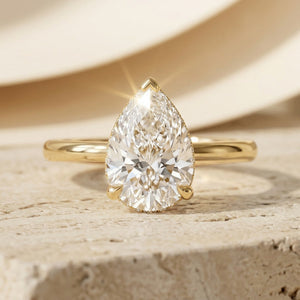
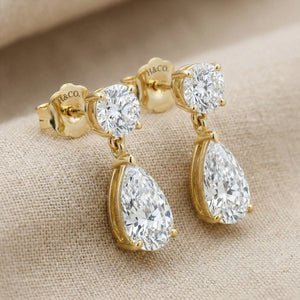
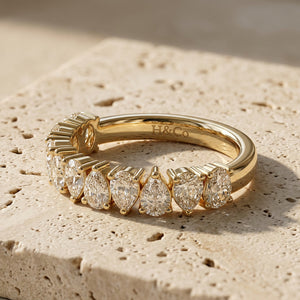
Pear: One pointed end and one rounded end — a teardrop. Maximises finger-lengthening effect; unique in both solitaire and drop settings.
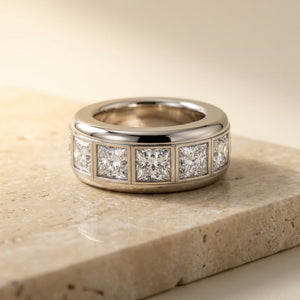
Princess: A square stone with a brilliant-cut pavilion — the most popular non-round cut globally. Retains most of the rough crystal (less waste), so princess cuts are often slightly cheaper per carat than round brilliants of equivalent weight.
Radiant: A rectangular or square cut with brilliance-optimised facets and cut corners — combines the length of an emerald cut with the fire of a brilliant.
Why Cut Quality Is the Most Important Grade
Among the four Cs — cut, colour, clarity, carat — cut has the single greatest impact on a stone's visual performance. A D/VVS1 diamond with a poor cut will look dead and glassy. A G/VS2 with an excellent cut will outperform it in every lighting condition. This is why Heritage & Co. selects stones based on cut quality first: the geometry of the facets is what creates the experience. Everything else is secondary.
To find the cut that suits your hand and your style, chat with us on WhatsApp. We carry oval, cushion, emerald, and marquise cuts in both moissanite and lab diamond — and we can show you how each performs in real lighting before you decide.
Explore by Cut at Heritage & Co.
- Oval Cut — elongated, finger-flattering, maximum size illusion
- Cushion Cut — soft corners, crushed ice brilliance
- Emerald Cut — step-cut elegance, hall-of-mirrors depth
- Marquise Cut — the most elongating silhouette of any cut
- All Engagement Rings