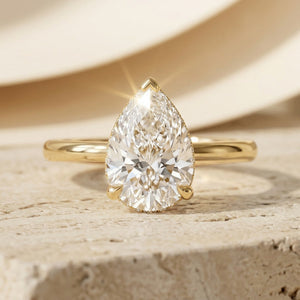
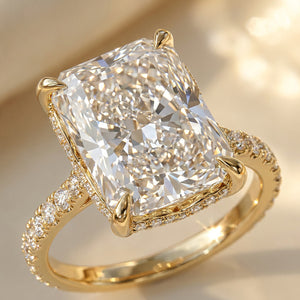
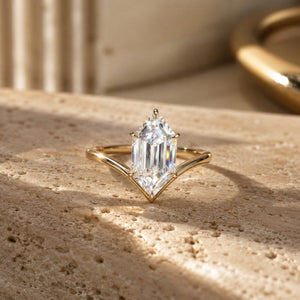
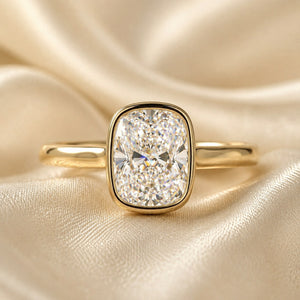
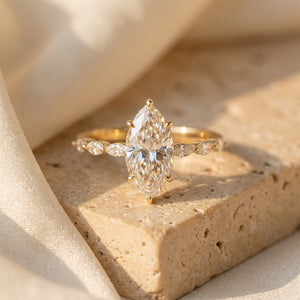
The most structurally important part of a solitaire engagement ring isn't the prongs that hold the stone. It's the arched metal beneath them — the sweeping curves that rise up from the shank on either side of the stone, cradling it from below. These curves are called the cathedral setting. And the reason they work, and the reason they carry that specific name, goes back to one of the most dramatic problems in medieval architecture.
The Problem That Built the Gothic Cathedral
In the 11th and 12th centuries, European cathedral builders faced a fundamental structural challenge. The ambition was height — tall, thin stone walls that would create soaring interior spaces filled with light. But stone walls, however thick, can only be built so tall before their weight causes them to buckle outward at the base. The taller the wall, the more outward thrust the roof structure generates at the top, pushing the walls outward from inside.
The solution that emerged in 12th-century France — first systematically deployed at the Basilica of Saint-Denis near Paris — was the flying buttress: a free-standing external arch that connects the wall high up (near the point of maximum outward thrust) to a massive external pier set back from the wall. Rather than trying to resist the outward thrust within the wall itself, the flying buttress redirects that force — conducting it outward and then downward through the pier, harmlessly into the ground.
Notre-Dame de Paris, Chartres Cathedral, Cologne Cathedral — every great Gothic cathedral's soaring height was made possible by the same engineering principle. The arch doesn't just decorate the exterior. It is load-bearing infrastructure. Without it, the walls would have collapsed within years.
The Same Principle in a Ring
A large centre stone — particularly a stone of 2 carats or above — exerts force on its setting. The weight of the stone acts downward through the prongs; any impact or physical stress is amplified by the lever arm of the prongs above the shank. Without additional structural support, the prongs must absorb all of that force themselves. Over years of daily wear, they can flex, fatigue, and eventually fail — loosening the stone.
The cathedral setting solves this identically to how the flying buttress solved the cathedral wall problem. Two arched rails of metal sweep up from the shank on either side of the stone's base, distributing the downward and lateral forces across a broader structure rather than concentrating them at the prong tips. The arches conduct stress away from the prongs, down the cathedral sides, and into the shank — the same path of force a flying buttress conducts thrust from wall to pier to ground.
The setting was named "cathedral" in the Victorian era, when jewellers working on large-stone rings recognised the visual and structural parallel. The arching forms both look like the nave of a Gothic cathedral and function on the same mechanical principle. The name stuck.
Why It Matters for a 5-Carat Moissanite
Heritage & Co.'s AETERNA AURORA features a 5-carat elongated cushion moissanite in a cathedral solitaire setting. At 5 carats, the stone measures approximately 12×10mm — larger than a small fingernail. At the density of moissanite (3.21 g/cm³), a 5-carat stone weighs exactly 1 gram. That gram sits at the end of a prong assembly that experiences impact from every direction during normal daily use — hands pressed flat, gripping objects, brushing surfaces.
Without cathedral support, the prongs holding a stone of this size and leverage would require either exceptional thickness (making the ring visually heavy and ungainly) or periodic tightening every few years as micro-fatigue gradually loosens the setting. The cathedral arch allows the prongs to remain elegant and appropriately sized while the arched rails carry the structural load — the same trade-off the Gothic builders made when they moved thickness from the wall to the external pier.
The engineering is not theoretical. Large solitaire rings set without cathedral support are among the most common repairs in jewellery — bent prongs, loosened settings, occasionally lost stones. Cathedral settings, properly made in solid gold, rarely need this intervention.
What a Cathedral Setting Looks Like
Visually, the cathedral setting elevates the centre stone off the finger. The arching sides create a pedestal — the stone sits taller and more prominently than it would in a lower, flush setting. This elevation does several things: it allows light to enter from below the stone (improving brilliance by letting light reach the pavilion from more angles), it creates a more regal, architectural silhouette on the hand, and it allows more of the stone's total profile to be visible when viewed from the side.
The cathedral also provides a natural frame for additional design elements — channel-set accent stones along the rising arches, milgrain detailing on the rails, or simply the clean, confident arc of polished gold. A well-made cathedral solitaire is a complete design statement without needing any additional embellishment.
Trade-Offs Worth Knowing
The cathedral setting's elevated stone profile, while visually striking, does sit higher off the finger than low-profile alternatives like the bezel setting or flush setting. For people who work with their hands, use touchscreens constantly, or sleep wearing their ring, the elevated stone can occasionally catch on fabrics or surfaces. For most wearers, this is a non-issue — awareness is all that's needed. For those with very active lifestyles or specific occupational concerns, a lower-profile bezel setting or a tighter four-prong low-set design may be a better fit.
The cathedral is also not ideal for very thin ring bands — the arch requires sufficient metal width to carry the structural function. Heritage & Co. dimensions all cathedral settings to ensure the metal geometry is appropriate for the stone size it carries. A 5ct stone gets cathedral arches designed for a 5ct stone, not a 1ct stone scaled up.
The Ring Worth Engineering
The best compliment a piece of jewellery can receive is that it still looks new twenty years later — that the stone is as secure, as centred, as perfectly presented as the day it was put on. Cathedral settings, in solid gold, with the right stone-to-arch proportion, achieve exactly this. They were borrowed from the greatest structural engineering tradition of the medieval world for very good reasons. The physics hasn't changed.
To see the AETERNA AURORA 5ct cathedral solitaire — or to find the right setting for your stone — chat with us on WhatsApp. We're happy to show you exactly what each setting style does and why it might or might not suit your stone, your hand, and your life.
Explore Heritage & Co.
- AETERNA Collection — cathedral solitaires in 14K gold, from R16,000
- CLARITAS Collection — IGI lab diamond in 18K gold, from R30,000
- Bezel vs Prong Settings — Which Is Right for You?
- All Engagement Rings